Homelands and Peoples
24 min read5,375 words
A homeland is not merely the place where you were born. It is the architecture of assumption that grew up around you before you had the words to name it, the way your household understood debt and obligation, the posture you learned for speaking to a priest, the distance you kept from strangers on a road, the first thing you noticed when something went wrong. By the time you are old enough to leave a place, it has already left its mark on you. You may spend the rest of your life on the water, in foreign ports, among people who do not share your instincts, and still find that certain things come reflexively: a particular wariness in negotiation, a habit of looking toward the church tower when you enter a new settlement, an impulse to introduce yourself by your trade before your name, or your name before your trade. These are the residue of formation, not choice. They are neither weakness nor virtue. They are where you began. This chapter is concerned with that formation. The continental powers, their politics, their histories, their ambitions in Mar de Oro, are treated elsewhere, as the forces they are on the world's stage. Here, those same powers are examined from the inside, from the level of the individual life shaped by them. What did it mean to grow up under the shadow of the Solarian Church? What did the counting-houses of Stroomdijk make of the children raised near them? What does a person from the high forests of Volkharov carry in their bones that a person from a Luminore print-town does not? These are the questions this chapter answers, not comprehensively, because no chapter can, but honestly enough to be useful.
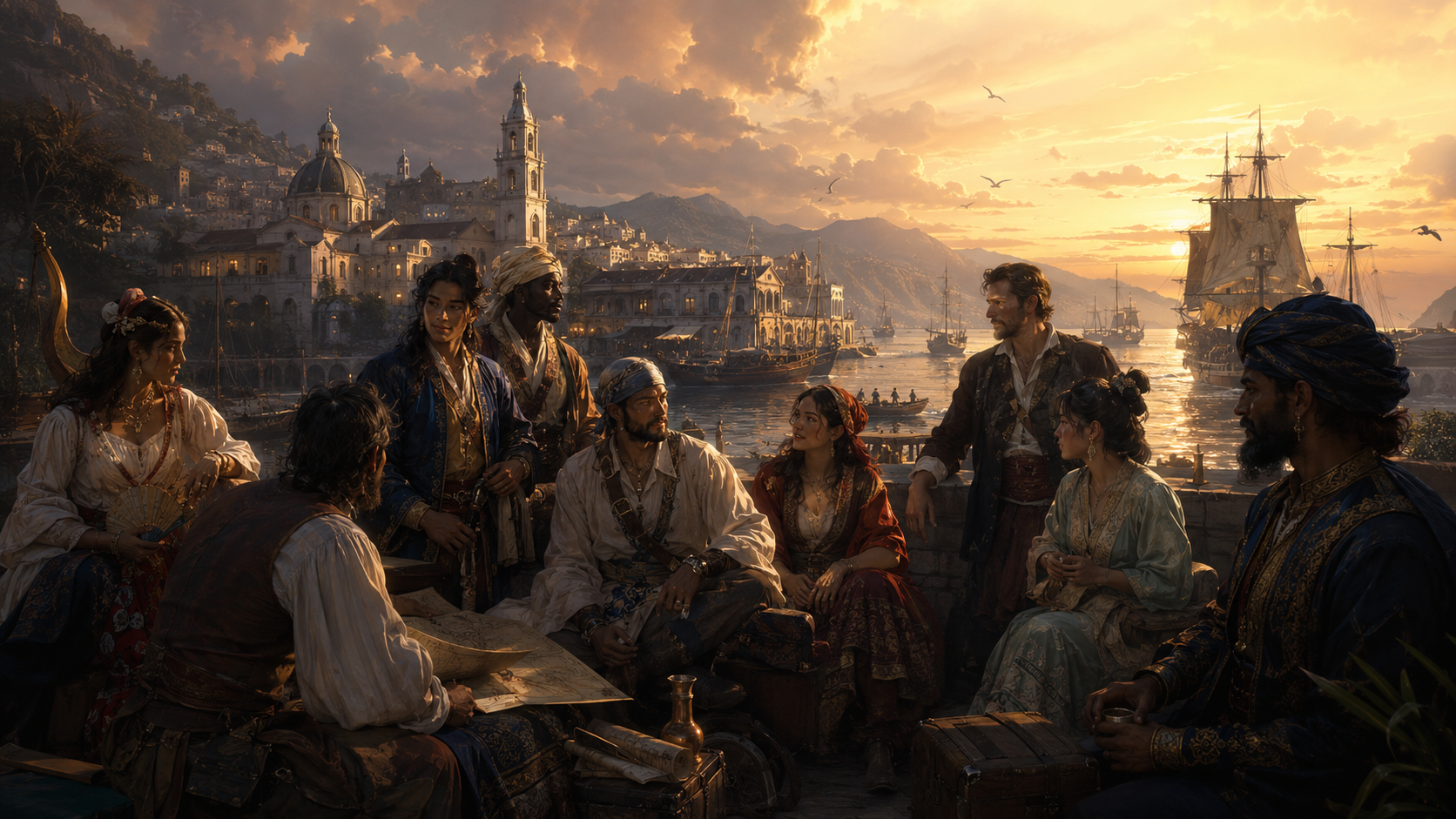
Formation, not choice#
There is one more origin that belongs here, and it does not map to any continental flag. Some who sail Mar de Oro were born into it, in a colonial port of raw timber and ambition, in a frontier mission town, aboard a vessel that became the only home they knew. Their formation is not Valdegraciense or Albionish or anything else with a clean name. It is layered, hybrid, improvised, and in its own way more complete than any single tradition. They belong to the last entry in this chapter, and they will recognize themselves there, or they will recognize the specific shape of not quite belonging anywhere, which amounts, after a while, to the same thing.
Valdegracia — the weight of heaven#
The weight of heaven, distributed through proper channels.
Valdegracia is old in a way that is not simply a matter of years. It is old in its bones, old in its certainties, old in the patient, unhurried confidence with which it has always assumed that the proper order of things is the order it embodies. The Church, the Solarian Church at its most elaborate and its most demanding, is woven into every Valdegraciense institution, every calendar, every form of address. To grow up in Valdegracia is to grow up inside a cosmology that has already answered the most important questions. The task is not to find meaning but to live in correct relation to the meaning that already exists. What the homeland made you is, before anything else, a person with an instinct for the vertical. Hierarchy in Valdegracia is not merely political; it is theological. Those above you are above you in the order of creation, and to acknowledge that correctly, through the right forms of address, the right deference in posture, the right silence at the right moments, is not submission. It is participation in something larger than personality. This shapes even those Valdegracienses who have shed their faith, or who wear it loosely. They still notice when hierarchy is being ignored, when deference is absent, when someone speaks to their better as an equal. It may not trouble them. But they notice.
Decorum is the social language. Not warmth, warmth comes later, inside relationships already established, but the formal exterior that says: I know how to conduct myself, and I expect you to know how to conduct yourself, and together we can proceed without embarrassing anyone. This can read as coldness to those who come from places where openness is the opening move. It is not coldness. It is the assumption that trust is earned through correct behavior over time, not offered freely at introduction.
Class in Valdegracia is ancient and legible. The great noble families carry the marks of their station in their names and their bearing and the way rooms rearrange themselves when they enter. A person of elevated birth named, say, Rodrigo Mirall de Casaverde knows that the second and third elements of that name do work in every room he enters on the continent. The de and the suffix and the lineage they carry are not ornament, they are a map of obligation and expectation running in both directions. Those of common birth know their names are simpler, Alonso, Inés, Marisela, Catalina, and understand what that simplicity signals without needing to be told. Middling birth is its own particular tension in Valdegracia: prosperous enough to aspire, undistinguished enough to be reminded of the ceiling. Merchant wealth is respected but not quite socially equivalent to land. This is a distinction that creates a great many restless second sons.
What a Valdegraciense carries out into the world is a specific relationship to ceremony. They are rarely flustered by ritual, by the formality of a court, the protocol of a religious procession, the careful choreography of a negotiation conducted through proper intermediaries. They have been trained since childhood to read these structures and move within them. And they carry, almost always, some version of the phrase that translates roughly as things have their due order, not spoken aloud, but present as a measuring instrument against which other people's chaos is quietly assessed.
Albionis — we do not say what we mean#
We do not say what we mean. We mean what we do not say.
Albionis produces a particular kind of person: one who has learned that directness is a form of vulnerability, and that the most serious things are best communicated sideways. The nation is maritime to its core, wind-shaped, island-minded, facing outward from necessity, and its culture bears the marks of a people who have always had to trade with strangers while maintaining some essential reserve that strangers could not touch. The result is a civilization that excels at understatement, prizes competence above almost everything, and will compliment you on your good seamanship at the moment when someone from elsewhere would embrace you like a brother. What the homeland made you is careful. Albionish formation instills a deep suspicion of excess, excess emotion, excess claim, excess certainty. The person who declares themselves certain, who speaks too loudly of their own virtue, who weeps openly at an introduction, is someone to watch carefully. Not because feeling is wrong, but because displayed feeling is a kind of nakedness that Albionish culture considers undignified. What you feel is your own business. What you do in the face of what you feel is the only thing others can fairly judge.
This produces people of extraordinary practical intelligence, often underestimated until it is too late to profit from the estimate. An Albionish person at sea or at a table or in a crisis is typically processing the situation faster and more accurately than their measured exterior suggests. They ask good questions. They do not fill silences with noise. They remember what you said three months ago and will notice if you contradict it now, though they will not say so immediately. Intellectually, Albionis prizes the well-reasoned argument and is comfortable with doubt, which is partly why its relationship with the Solarian Church has always been polite and slightly cool, and why the Luminary Fellowship found real purchase there in the reform years.
Class in Albionis is complicated by the sea. The great maritime fortunes scrambled the old landed order two centuries before the handbook opens, and while the aristocracy remains powerful, there is a parallel prestige attached to naval command and maritime mercantile success that does not exist in quite the same way elsewhere. A family name like Greaves or Whithorn or Saltwood signals something different from Harwick or Crispin or Elspeth, the former carry place and sometimes old land, the latter carry common stock, trades, specific harbors. But a common-born ship's captain with thirty years of experience will be treated with a deference in Albionis that would confuse a Valdegraciense observer. Middling Albionish families, the merchants, the lesser navigators, the doctors, the clerks, inhabit a world of careful self-improvement and quiet anxiety about station, expressed through the careful maintenance of the right accents and the right pastimes.
What an Albionish person carries is the pause. Before speaking in any charged situation, there is a breath, sometimes two, in which something is assessed and some portion of the true response is withheld for later, or forever. New acquaintances often read this as coldness. Old friends know it as the opposite, as the space in which something real is being formed. They also carry a specific relationship to the sea itself: not romantic, never romantic, but intimate, the way a person is intimate with something that could kill them and often has tried.
Stroomdijk — everything has a price#
Everything can be arranged. Everything has a price. Neither statement is cynical.
Stroomdijk is not subtle about what it values. Wealth, not inherited wealth, not blessed wealth, but earned wealth, demonstrated wealth, wealth that moves and multiplies through the application of intelligence and effort, is the primary idiom in which the culture speaks. This is not vulgarity. It is a philosophy, or near enough: the idea that prosperity is evidence of practical virtue, that a person who can calculate what something is actually worth and act on that calculation is a person who has understood something real about the world. Sentimentality, by contrast, is suspect, not because feeling is wrong, but because sentimentality makes bad decisions and other people pay for them. What the homeland made you is practical in a specific, relational way. Stroomdijk people are often multilingual by necessity, the nation's trading empire requires it, and the docks of Harenstede or Vlissmeer will have six languages running simultaneously on a busy morning. This creates a particular flexibility of mind: the ability to hold multiple framings of a situation, to find the overlap between your interests and the other party's interests and work from there rather than from principle alone. This is not dishonesty. It is the natural result of a culture that has always understood negotiation as a collaborative act rather than a contest.
Trust in Stroomdijk is real and is taken seriously, which is why its breach is taken more seriously here than almost anywhere else. The handshake that closes a deal in a Stroomdijk counting-house is as binding as any church oath in Valdegracia, and the social consequences of breaking it are proportionally severe. A person who cheats their partner does not merely lose a partner; they lose the entire network that partner inhabits, and in Stroomdijk networks are everything.
Names in Stroomdijk reflect the nation's commercial and cartographic obsession. Family names are typically constructed as van followed by a place, van Dokkum, van den Bree, or de followed by an occupation or descriptor: de Vries, de Waal, de Klerk. Given names are sturdy, affectionate in their plainness: Anneliese and Wouter and Saskia and Gerrit and Lieselotte are names from a culture that does not adorn unnecessarily. They name children for grandparents, for old business partners, for harbors where things went well.
Class in Stroomdijk is theoretically permeable, which means it is practically more rigid than it appears. The great merchant families have been great for four and five generations, and their wealth has converted itself into the kind of social infrastructure, the academies, the guildhalls, the philanthropic endowments, that looks like merit but functions like inheritance. Common-born Stroomdijkers can and do rise through the trading companies, and this is genuinely true, genuinely celebrated, and slightly less common than the myth suggests.
What a Stroomdijk person carries is the habit of assessing. Walking into a room, meeting a new person, arriving in a new port, the first seconds are always a calculation, not hostile, not cold, simply accurate. They are doing what they were trained to do: reading the situation for its actual structure, not its presented one. They are also, though they rarely announce it, the most likely of any continental nationality to be carrying at least two spoken languages and the rough vocabulary of a third.
Luminore — the republic is the faith#
The republic is the faith. The faith is the republic. This is not a confusion.
Luminore is a Solarian republic, and it has organized its entire civic life around a proposition that the continental powers find either admirable or unsettling depending on how much they need the Church: that the republic and the faith are not competing claims but expressions of the same underlying order. The Solarian Communion in Luminore is genuine and practiced. Its feast days are public occasions. Its cathedral is among the oldest on the continent. What distinguishes Luminore from Valdegracia is not the presence of the faith but the relationship between faith and state, constitutionally bounded, mutually respectful, and never permitted to fully merge. The result is a culture that takes both civic and religious life seriously as parallel obligations. The Conseil Civique, the elected assembly, is where secular matters are resolved. The cathedral is where sacred ones are. A Luminoran is expected to be competent in both registers, which produces a particular kind of formation: a person who understands institutions as genuine things, who knows the difference between what a law says and what it means, who treats both spiritual and civic claims as worthy of honest examination rather than reflexive deference.
To grow up in Luminore is to grow up in a culture that treats intellectual life as a common inheritance, not the privilege of clergy or nobility. Literacy is a civic virtue. The press is a civic institution. The university is where questions that cannot be resolved in the assembly are examined by the methods the assembly respects: evidence, argument, honest conclusion. This produces a particular kind of person: one who believes that disagreement, honestly conducted, is not a failure of community but its highest expression.
What the homeland made you is comfortable with argument in a way that people from other nations often find alarming. When a person from Luminore disagrees with you, they say so, explain why, and expect you to explain why you think you are right. The conversation that follows is not a conflict. It is the whole point. Théodore, Camille, Lorenzo, Adèle, Renaud: the names Luminore favors have a civic clarity to them, and family names are often occupational or scholarly in derivation, the Lectiers and Forgiers and Moulinards, names that remember a craft or a practice. There is no shame in a name that remembers work.
Class in Luminore is real but subject to interrogation, which means the interrogation never quite resolves it. The old aristocracy exists and holds land and title, but the educated middling class, lawyers, physicians, printers, jurists, natural philosophers, has been mounting a slow, document-by-document argument against the assumed superiority of birth for a century and a half, and has achieved a kind of parallel prestige that makes the two systems coexist in permanent productive friction. Common birth is not destiny in Luminore, provided you are literate; literacy is considered a moral as much as a practical matter, and the philanthropic academies that offer it to the poor are among the most honored institutions in the republic.
What a Luminore person carries is the citation. In conversation, when they make a claim, they are mentally noting the sources that support it, and if you ask them where they heard that, they will tell you precisely and will want to know your source in return. They carry a Solarian faith that is genuine and civic in its expression, observed through public feast days and community rite rather than personal mysticism, and a deep conviction that the Architect's design and the republic's design are, properly understood, the same argument. They also carry a specific relationship to silence: it makes them anxious. Silence in a Luminore household means something has gone wrong. Argument means everything is fine.
Duchy of Heller — what we built, we built ourselves#
What we built, we built ourselves. The papers came later.
The Duchy of Heller is not old. It is twenty years old, and its autonomy within Valdegracian dominion was acknowledged less than a year ago. It has no ancient highland tradition, no centuries of accumulated proverb. What it has is the memory of the crossing, the Compañero expeditions that brought the founders to the New World before any crown had organized a mandate to follow them, and the twenty years of deliberate, practical construction that turned a settlement into something that could not be ignored. Its founders were Valdegracian in origin, Solarian in faith, and Compañero in loyalty, which is to say, bound to one another by the specific oath of sworn crew solidarity that the expeditions formalized and that the Duchy still honors as the closest thing it has to a founding covenant. The names the Duchy carries are Valdegracian in register: Hernán, Francisca, Cosme, Lucía, Rodrigo, Esperanza, names from the same tradition as the old continent's Solarian world, carried across the sea and planted in New World soil. Family names follow Valdegracian patterns, de Heller now common as a territorial marker alongside the old patronymic and place-based forms. There is no shame in a name that arrives from elsewhere. In the Duchy, every name arrived from elsewhere.
Faith is Solarian, genuinely so, and carried with the particular quality of people who practiced it far from any ecclesiastical hierarchy that could oversee it. The priest in a Hellerite settlement is trusted because the community trusts them, not because Rome appointed them. The feast days are kept. The sacraments are observed. And the relationship to the institutional Church is respectful, somewhat wary, and shaped by the fact that the Offices of Inquiry denounced Generalis Costilas on the mainland, which is a fact the Duchy has not forgotten and does not discuss with people it does not trust.
What the homeland made you is direct in the way of people who had too much actual work to do for elaborate courtesy. If something is wrong, you say so, because pretending otherwise is a disrespect. If something is good, you say that too, once, and once from a Hellerite is understood to be worth considerably more than ten compliments from someone for whom praise costs nothing.
Class in the Duchy is felt but largely unspoken. There is a governing structure: the two Dukes, the officers, the civil administrators that the founding generation built from competence rather than inheritance. What is not admired is the person who arrived with a title and expected it to do work for them. The Duchy's social question is always the same: can you do the thing? The answer to that question ranks you, and no other ranking carries the same weight.
What a Hellerite carries is the specific solidarity of the crossing: the knowledge that the community they belong to was built by people who bet everything on a place that did not yet exist and then made it exist. This is not nostalgia. It is a structural fact about what the Duchy is, and it produces a particular relationship to loyalty, to the people you are responsible for, and to the idea that what you build with your own hands is the only thing that is genuinely yours. They also carry the Compañero instinct, a deep alertness to whether the people around you will hold when things get difficult, because in the Duchy's founding generation, that was the question everything else depended on.
Eisenmark — the machine works#
The machine works because every part knows its place. So does the city. So does the man.
Eisenmark is not the oldest of the continental powers but it is in many ways the most legible: a nation whose virtues are so clearly organized, so visibly expressed in its institutions, that a visitor can read its values in the geometry of its cities before they have spoken to a single citizen. Order is not a means to an end in Eisenmark. It is the end. The regulated street, the clock tower that keeps the same time as the clock tower in the next district, the army that drills in the rain because the rain is not a reason, these are not impositions on Eisenmark life. They are its expression. The nation believes, with a theological conviction that it would not necessarily call theological, that the disciplined arrangement of human effort produces outcomes that no other arrangement can, and that this belief is not merely practical wisdom but something close to righteousness. The Velasian theological strain, a form of Solarian doctrine that emphasizes divine providence as expressed through orderly human institutions, is strongest in Eisenmark, and its influence is felt in the culture's conviction that to do your duty, precisely and without complaint, is a form of worship. This is not the faith of mystics or philosophers. It is the faith of administrators and engineers, and it produces administrators and engineers of remarkable quality.
What the homeland made you is capable of functioning inside structures in a way that other nationalities sometimes cannot. Where a Luminore person chafes at authority without justification, an Eisenmark-raised person understands that the structure itself has a value independent of any particular authority who inhabits it. The question is not whether you agree with the person above you. The question is whether the chain of obligation is clear and correct, and whether you are holding up your portion of it. Friedrich, Hannelore, Dietrich, Sofie, Rüdiger, the names Eisenmark favors are clean in their consonants, without unnecessary ornamentation, and family names are typically occupational in derivation, Schreiber, Zimmermann, Schneider, or compound constructions that denote a specific function: Langstraße, Neufeld, Kleinhans. The names remember what your family did, what place they came from, what role they occupied.
Class in Eisenmark is expressed through function. The aristocracy exists but governs primarily through military and administrative rank, and the two overlap so thoroughly that it becomes difficult to say where one ends and the other begins. A common-born person who demonstrates the specific qualities Eisenmark prizes, precision, reliability, technical mastery, can rise through the military or the great administrative bureaus to a place of considerable standing. This is genuinely true, not merely aspirational. Eisenmark promotes on demonstrated capacity with a consistency that is the envy of less organized nations.
What an Eisenmark person carries is the schedule, or the mental equivalent of one. They are the most likely of all continental nationalities to be punctual, to resent the absence of punctuality in others, and to experience a disproportionate satisfaction when a complex operation, a voyage, a negotiation, a campaign, completes on time. They also carry a quality of correctness in physical bearing that is nearly impossible to entirely shed, even after years in the colonial ports: the straight spine, the measured step, the way they stand in a room that tells you, if you know the language, exactly where they were trained.
Volkharov — the land is older than any name#
The land is older than any name we have put on it. We are learning patience.
Volkharov is vast in a way that its inhabitants carry as a kind of interior weather. The nation extends further east and north than any other continental power, into territories that shade from productive steppe to boreal forest to something approaching the edge of the habitable world, and to grow up there is to grow up with scale as a companion, the kind of scale that makes human ambition seem briefly, instructively small. This does not produce passivity. It produces endurance, which is a different and more useful thing. The Oraclean Communion is the faith of Volkharov, and its influence runs deep, not in the administrative, institutional way that the Solarian Church runs through Valdegracia, but in the texture of feeling, the way people relate to the sacred as something vast and older than names, something the Oracles saw and recorded but did not create or control. The religious sensibility of Volkharov is communal rather than hierarchical: the congregation carries the faith, not the institution, and the priest or reader is a servant of the congregation's understanding, not its authority. This produces a specific relationship to spiritual life, interior, serious, reluctant to display, deeply felt in silence in a way that no ceremony can fully contain.
What the homeland made you is patient in the specific way of a people who have learned that winter will end, but not on a schedule you set. Volkharov people absorb hardship without collapse; they absorb it and continue, and this capacity is so deeply embedded that it often does not look like anything from the outside. They simply do not stop. This can be mistaken for stubbornness, or for a lack of imagination about alternatives. It is neither. It is the knowledge that endurance is its own strategy, and one of the more reliable ones.
Community is the organizing principle. Ilya, Nadia, Vasily, Svetlana, Dmitri, the names are worn easily, used without the social loading that some nations apply to given names; in Volkharov you are addressed by the familiar form of your name by people who have shared your fire, and the distinction between those who have and those who have not is one of the culture's primary social coordinates. Family names are patronymic in the most common tradition, endings of -ov and -ev for men, -ova and -eva for women, naming you as the child of your father's line, though place-based names are common too among families with deep roots in a particular valley or river-bend. You are the child of the land or the child of the man who tended it; either way, you are a child of continuity.
Class in Volkharov is present but expressed less through the visual apparatus of status, the title, the address form, the architectural statement, than through network and obligation. The great families are great because everyone in a hundred-mile radius knows whom you can call on in a crisis and who will call on you. This web of mutual obligation is the actual fabric of Volkharovian society, and navigating it well is the primary social skill.
What a Volkharov person carries is the silence that does not need to be filled. In company, they can be still in a way that disconcerts people from more voluble nations, and in that stillness they are not absent, they are fully present, processing, present in the way that only someone accustomed to long dark winters has learned to be present. They also carry, usually, some form of the Oraclean practice of remembering, the habit of marking significant moments privately, in the interior, as a kind of internal record that the world does not need to see.
Mar de Oro, colonial-born — you are from everywhere#
You are from everywhere. You are from here. Those are the same thing now.
There is no continental flag that covers the person who was born in Portaverde when three ships from different nations were anchored in the harbor, whose mother was Valdegraciense and whose father died at sea before they were old enough to remember his accent, who learned to read from a mission brother who was himself born three thousand miles from the mission in question. There is no single formation that applies. And yet formation happened, it always happens, and the formation of the colonial-born is, in its own way, as thorough and as specific as any the continent produces. What the colonial port makes you is a reader of people in the most technical sense. When your world is composed of Albionish merchants, Stroomdijk factors, Valdegraciense clergy, Duchy of Heller craftsmen, and the indigenous harbor pilots whose knowledge of the local currents is worth more than all of their cargo put together, you learn early that every person is operating from a system of assumption that is not yours and not universal. This is not theoretical knowledge. It is survival knowledge. The colonial-born child who cannot read which register to use with the customs officer and which with the dockhand is a child who will have a harder life than necessary. By adulthood, this skill is so automatic it does not feel like skill anymore. It feels like breathing.
Names in Mar de Oro are an archaeology. A colonial-born person might carry a saint's name from the Solarian calendar, Sebastião, Annunciata, Lourdes, alongside a family name from a homeland their parent only half-remembered, alongside a nickname that stuck from childhood and that the harbor pilot who coined it is long dead. The name is not a unity. It is a history. This is not felt as a lack. It is felt, when it is felt at all, as an accurate description of what a person is: layered, assembled over time, not made in one place.
There is no single faith among the colonial-born, which means there is also no automatic community of faith, no congregation that claims you by origin. Some follow the denomination of a parent. Some have assembled a practice from multiple traditions. Some have, with the pragmatism the colonial world encourages, adopted whatever faith is most useful in whatever port they are working, which is not cynicism but a form of spiritual adaptability that the continent finds disquieting for reasons that say more about the continent than about the colonial-born.
Class in Mar de Oro is determined by two things: what you can do and who knows you. Continental birth-class does not translate cleanly to the colonial context, where a minor noble without connections will eat worse than a common-born quartermaster with thirty years of local knowledge. Reputation in a specific network of ports is the primary currency, and it is built over time, in the same way trust is built everywhere, by doing what you said you would do until enough people have seen you do it.
What the colonial-born carry is a specific relationship to belonging, or rather, to the absence of it. You have never fully belonged to any single place, and you have learned, by necessity, to need it less than people raised on continental soil think they need it. This can look like rootlessness, and sometimes it is. But at its best it is something else: a freedom of self-definition that the homeland-bound cannot easily access, a capacity for becoming that does not require permission from a tradition. You are from Mar de Oro. You made yourself in the only place available. That place was the crossing, the water between, and you have been crossing ever since.
Mar de Oro is far enough from the continent that the institutional memories of the great powers attenuate here. This is what the colonial world represents to people who arrive from elsewhere, not freedom, exactly, but distance, and distance, the possibility of delay. The debt you owe in Coronaverde may not have a collector in Port Aurum. The reputation that made you unemployable in Stroomdijk may not have preceded you to the Estuary settlements. The name that closed doors in the old world may mean nothing to a harbormaster who has never heard of the family that ruined it. The powers are present here too, of course, their agents and their records and their long memories reaching across the water, but the crossing takes time, and in that time, people rebuild. The colonial-born have grown up watching this happen, watching people arrive with closed faces and open futures, watching the slow work of becoming someone new in a place that does not yet know who you were. They understand, better than almost anyone, both the genuine possibility of reinvention and the specific ways it tends to fail: the past that catches up, the habit that reasserts itself, the letter that arrives three seasons late and finds you anyway. The colonial-born character who stays in Mar de Oro is often, consciously or not, holding the door open for the next person who needs what this place once offered someone else.
Continue reading