Enter the Golden Sea
8 min read1,691 words
A tabletop role-playing game is a shared story created through conversation. This prelude is written for anyone new to the hobby, and for veterans who want to see how Mar de Oro likes to be played. No one at the table knows the whole story before it begins. It emerges from the choices made together.
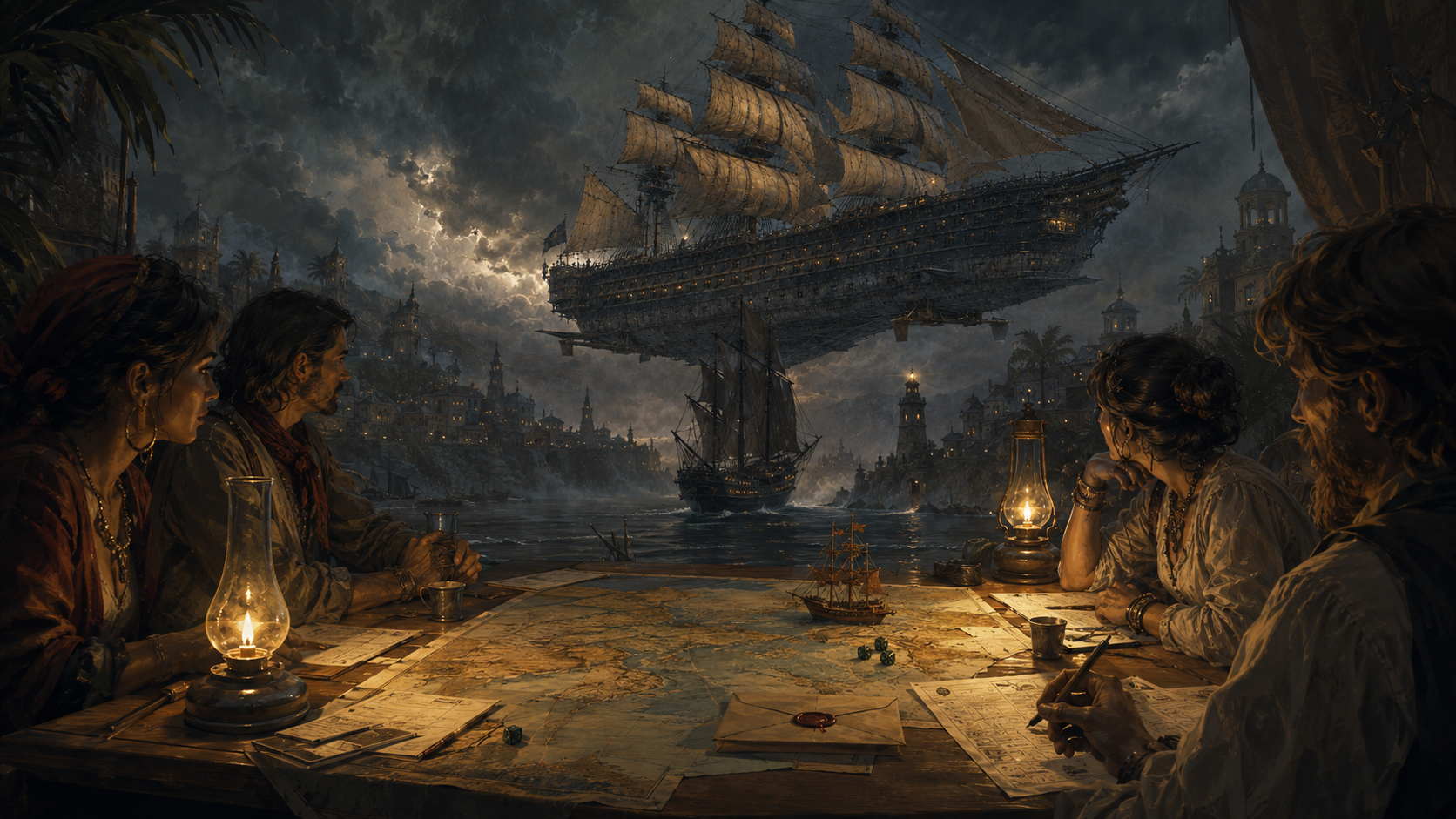
What tabletop role-playing is#
One person takes the role of the Game Master. The Game Master describes the world, portrays its inhabitants, presents dangers, and explains how the setting responds to the characters. The other participants each portray a player character. These characters might be explorers, soldiers, investigators, scholars, sailors, smugglers, diplomats, or people drawn into events far larger than themselves.
Most tabletop role-playing follows a simple rhythm: the Game Master describes the situation, the players decide what their characters do, the rules resolve uncertainty, and the world responds. That cycle of description, choice, uncertainty, and consequence is the heart of play. First, the Game Master describes the situation: where the characters are, what they can immediately perceive, and what appears to be happening. Second, the players decide what their characters do. They may investigate, ask questions, speak to someone, make preparations, take a risk, or attempt something unexpected. Third, the rules resolve uncertainty. When the outcome matters and success is not guaranteed, the Game Master may ask for a roll. A successful result might provide information, create an advantage, or overcome an obstacle. A poor result does not have to end the scene. It might introduce danger, lost time, unwanted attention, a difficult choice, or a new complication. Fourth, the world responds. The Game Master describes the consequences, and the conversation continues.
Players can describe dialogue indirectly: "My character asks the harbourmaster why the eastern district is dark." That is always acceptable. Many groups, however, find that they get more from the game when they also play important conversations out in character. Simply speak from your character's point of view. Players can move naturally between direct dialogue and description. The purpose is not to perform perfectly. The purpose is to give everyone at the table more to play with.
Everyone creates the story. The Game Master prepares situations, places, people, secrets, and conflicts. The players decide what their characters value, whom they trust, what risks they accept, and what lines they refuse to cross. The rules and dice introduce uncertainty. The story emerges from all three. A prepared investigation might become a negotiation. A quiet voyage might become a rescue. An enemy might become an ally. The players are not following a hidden script. Their decisions change what happens.
Mar de Oro is a setting of contested islands, early air power, fading certainties, and secrets that powerful institutions would prefer to keep buried. Your group might explore an island removed from official charts, investigate the disappearance of an Éterlumin transport, or negotiate between colonial authorities and a local community. You might hunt a saboteur aboard an airship crossing the Golden Sea, recover sealed records from an abandoned Solarian archive, or protect a Dragon Line station while rival forces close in. Combat may occur, but violence is rarely the only meaningful solution. Information, reputation, timing, alliances, and difficult conversations can be just as important as weapons.
Some groups enjoy long conversations, political negotiations, and careful investigation. Others prefer daring expeditions, airship battles, infiltrations, or desperate escapes. Many combine all of them. You can speak in character, describe your actions from outside the character, or move naturally between both approaches. Before beginning, the group should agree on the tone of the campaign, the subjects it wants to explore, and any material it prefers to avoid. Anyone should be able to request a pause, clarification, or change when a scene becomes uncomfortable. A good game is measured by whether the people at the table are engaged in the story they are creating together.
To play in Mar de Oro, you need a group of participants, one person willing to act as Game Master, characters with reasons to become involved, a situation that demands a decision, a set of rules for resolving uncertain actions, dice or another resolution method required by those rules, and a shared understanding of the game's tone and boundaries. Mar de Oro is designed as a system-neutral setting. You can begin with the official Quickstart, The San Telmo Incident, use one of the available conversion guides, or adapt the setting to a role-playing system your group already knows. You do not need to understand the entire world before beginning. Choose an island. Introduce a problem. Give the characters a reason to care. Then ask the most important question in any role-playing game: what do you do?
Example of play, the dark harbour#
The following scene shows how a game might unfold. The group is using rules in which the Game Master calls for a roll when an action is uncertain. The exact names of skills, attributes, or results will depend on the system being used.
The charactersLucía Ferran is a Valdegracian navigator with experience reading naval signals. Elias Ward is an Albionic physician who left military service under uncertain circumstances. Mara Venn is a local guide who knows the roads, inlets, and families of San Telmo. The characters are travelling aboard the merchant airship Santa Aurelia. They are carrying medical supplies and a sealed message intended for the San Telmo harbour authority.
Approaching San TelmoThe Game Master sets the scene: "The Santa Aurelia descends beneath the storm clouds. Rain strikes the deck and streams from the rigging. San Telmo should be visible below, but almost every light in the eastern harbour has gone dark. The Dragon Line receiver beside the helm gives three short pulses. Then silence. Captain Ortez turns toward you. 'Those lights were burning when we passed this coast yesterday. I need to know whether we are landing in a harbour or a trap.' What do you do?"
Lucía's player answers: "I take the navigation glass and study the harbour. I am looking for signal lamps, ship movement, or anything that suggests the darkness is deliberate." The Game Master notes that the rain and distance make that difficult; her naval experience will help, but there is a risk that someone below will see her standing against the observation window. She takes the risk and rolls, a success, with a complication.
The Game Master narrates the result: "The harbour lights have not failed. They have been covered. You also see a black sloop rising slowly beneath the Santa Aurelia. It carries no visible colours. As you lower the glass, a shutter opens in the customs tower. A signal lamp flashes directly toward you. Someone has seen you."
Lucía tells the captain about the sloop, quietly. Mara's player asks whether she recognises the signal from the tower. She does, an old harbour warning: Do not land. Authority compromised. Elias asks how far they are from the landing platform. Less than two minutes at the current descent. He heads for the cargo hold to secure the medical crates, then reconsiders and asks a deckhand to do it so he can stay on deck.
The first conversationA voice carries from the black sloop through a speaking trumpet. "Merchant vessel, reduce lift and prepare to receive harbour officers." Captain Ortez looks at the three of them. "They are close enough to fire into the keel. I cannot outrun them in this weather."
Lucía takes the trumpet and, as her character, calls back: "Identify your vessel and commanding authority." The officer answers, "San Telmo emergency patrol. You will comply immediately." Lucía: "An emergency patrol without colours?" Officer: "The storm tore them away." Lucía: "Remarkable. It also appears to have covered every harbour lamp with identical black canvas."
The other players laugh, but the conversation remains part of the scene. There is a pause aboard the sloop. When the officer speaks again, the polite tone is gone. "Reduce lift. This is your final instruction."
While Lucía keeps him talking, Mara watches the customs tower. She sees movement behind the lamp. Someone is repeating the same signal, Do not land. Authority compromised. Then the lamp disappears. Elias asks whether the sealed message can tell them anything useful. It bears the harbour authority's seal; they were instructed not to open it. Elias, in character, to Mara: "If the authority has been compromised, our instructions may have been compromised with it." Mara: "And if the seal is genuine, opening it could make us enemies of whoever still controls the harbour." Lucía: "We already have enemies beneath the ship." Elias breaks the seal.
A choice changes the sceneInside the envelope is a single sheet. It contains a list of ship names, arrival dates, and cargo numbers. Several entries have been marked with a black circle. The Santa Aurelia is the final name on the list. Beneath it, someone has written: The inspection crews are not harbour officers. Do not allow them below deck. At that moment, grappling lines strike the side of the ship.
The scene continues from the characters' choices. They might resist the boarding party, conceal the cargo, escape into the storm, negotiate for time, contact the person in the tower, or allow the boarding and attempt to learn who the false officers serve.
What happened during the exampleThe Game Master introduced a situation containing danger and unanswered questions. Lucía's player investigated. The roll succeeded, but the complication allowed the opposition to notice the ship. Mara's knowledge revealed the meaning of the signal. Elias's player avoided separating himself from the group, then made the consequential decision to open the message. The conversation with the officer was played directly. This gave Lucía's personality room to emerge and allowed Mara to act while the officer was distracted. The scene did not stop because the players discovered the trap. Their discovery changed the nature of the danger. That is often how play works in Mar de Oro. Answers create new decisions.
Your story begins hereThe Golden Sea is crossed by warships, merchant fleets, Dragon Line signals, whispered alliances, and people carrying truths that could change the balance of power. Gather your crew. Create your characters. Enter Mar de Oro.
Your story begins here
Take the next step aboard
Gather your crew, create your characters, and enter the Golden Sea.
Continue reading