Ships of Sea and Sky
17 min read3,727 words
A ship is never only transportation in this setting. It is a community, a hierarchy, a workplace, a machine, a home, a prison, a symbol, and often the most honest portrait of a society in miniature. A frigate and an airship produce different forms of life. The frigate teaches endurance, salt, labor, hierarchy, and the long intimacy of travel at sea. The airship adds engineers, containment discipline, and the permanent awareness that the vessel remains aloft by cooperation between human discipline and a substance with no patience for bravado. For campaign play, ships are ideal because they force people into relation. Secrets travel badly in close quarters, but so do fear, loyalty, class resentment, devotion, competence, and grief.
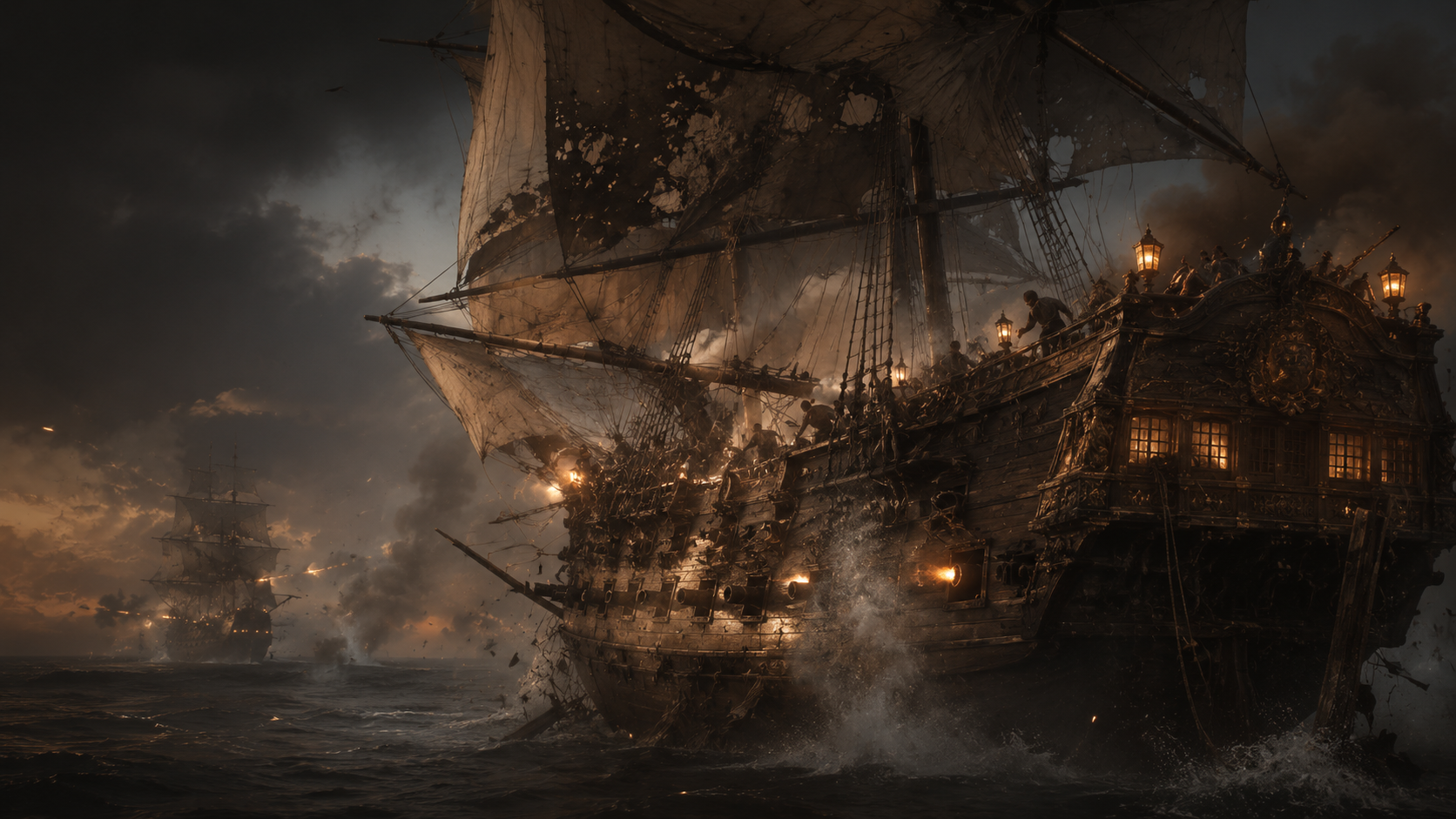
Fleet doctrine: what the powers believe about war at sea and sky#
The great powers do not agree on what naval power is for, and the disagreement is not merely theoretical. It is built into the hulls of their vessels.
Valdegracia operates under the motto Compostura. Conflagración. Composure. Conflagration. The Armada de Dominio, whose Mar de Oro formation is the Escuadra del Mar de Oro and its elite División del Dragón, is built on the belief that the side with greater structural mass and disciplined fire wins when both sides are willing to press the engagement. Hold the line, absorb damage, and let the accumulated weight of a sustained broadside do what maneuvering cannot. Valdegracian vessels are bulkier than their counterparts, with internal Éterlumin systems integrated into the hull and armor plating that lighter designs cannot match.
Valdegracia: Justicar and Cruzado#
The Justicar-class ship of the line is the fullest expression of this doctrine: a vessel so structurally formidable that its presence at a strategic harbor is a political fact before it fires a single shot. Its broadside suppresses everything within the line of fire, not merely the target, pressing all enemies in its path to seek cover or hold position under fire. A Justicar on station is there to be seen, to anchor the presence of empire, and to be the thing every other vessel must calculate against when planning anything in the surrounding waters.
The Cruzado frigate carries this logic at smaller scale. Its hull construction allows the crew to brace against incoming fire and halve the damage of a broadside through structural reinforcement and discipline, but it pays for this in turning radius. Changing course requires time that a faster opponent can exploit. Valdegracian captains know this and plan for it. The Cruzado is not meant to chase or evade; it is meant to be where it needs to be before the engagement begins and to hold that position until the engagement is decided.
What defines Valdegracian doctrine is not individual vessel performance but formation integrity. The Justicar-class anchors every allied vessel within its immediate formation, stiffening the line as a whole, and the doctrine is built around maintaining that formation under fire long enough for the cumulative weight of disciplined broadsides to break the enemy's ability to sustain their own. A Valdegracian admiral who loses formation cohesion has lost the engagement on doctrinal terms before the damage tallies are even read.
Albionis: Banshee, Spectre, Wright, and the Ghost Squadron#
Albionis operates under the doctrine Silence before the storm, and the Royal Fleet Command's Mar de Oro formation, the Expeditionary Flotilla's 13th Engagement Group known informally as the Ghost Squadron, is built around the assumption that the engagement is already lost if it begins as the enemy intended. Where Valdegracian vessels are built to absorb punishment through mass and armor, Albionis vessels are built lighter and faster, carrying firepower that punches well above what their size and construction would suggest. The design philosophy accepts that a single sustained broadside from a Valdegracian opponent could do serious damage, and answers that risk by ensuring the Albionis vessel fires first, repositions before the return volley arrives, and engages on its own terms or not at all.
The Banshee-class battlecruiser is the command and coordination platform of Ghost Squadron operations. It is the heaviest vessel in the Albionis Mar de Oro formation and, unlike the frigates that operate alongside it, is built to absorb fire while maintaining the coordination role. It carries an integrated reconnaissance network that feeds its captain situational awareness ahead of any engagement, which means the Banshee almost always acts before the opposing vessel has finished reading the situation. It is designed to operate in coordination with the Bureau of Correspondent Affairs' Obsidian-class, a vessel that does not appear in the official fleet registry, such that the Bureau's advance positioning determines when and how the Banshee commits. When an Albionis captain takes an incoming broadside, the Banshee can immediately return fire rather than waiting for the next volley rotation, a capability that changes how opposing captains calculate the cost of engaging it directly.
The Spectre-class frigate is the workhorse of the Albionis fleet, a sturdy all-around vessel rather than a light-hulled specialist. Her bow mounts five heavy cannons and her broadside carries eleven medium pieces, giving her enough weight to dispute the line while still using the rotating charge loads that pierce Valdegracian reinforcement at close range. After firing, she can ignite a drive burst that both accelerates the ship and lays a dense smoke trail, repositioning under cover before the return volley can find her. The Wright-class is the formation's frontal assault specialist: built around a heavy bow battery of eight heavy cannons and four medium pieces, it closes head-on and delivers a concentrated rake that few hulls can absorb. The attack leaves the crew unable to answer effectively for the following round while they reload, which means the maneuver is decisive when it lands and dangerous when it does not. The Wight skirmisher operates at the edges of any engagement, using storm cloud and coastal mist to approach without being seen and moving fast enough that engaging it directly is rarely worth the cost. It does not need to destroy a target; it needs only to make the target less effective, and the sustained harassment of a Wight presence degrades the accuracy and coordination of heavier vessels in ways that compound across the length of a longer engagement.
The Duchy of Heller: Cazador, Santo, Aurora Ventus, Veloz, and Helios#
The Duchy of Heller operates no ships of the line and does not pretend to. What the Duchy has built over two decades in the archipelago is a force whose individual vessels are designed to complement each other in the same way that a much larger fleet would, at a scale the Duchy's resources can actually sustain. The Cazador frigate is the interceptor: its boiler system reaches operational speed faster than any comparable vessel, its guns are tuned for precision fire against rigging and propulsion rather than hull reduction, and it is fast enough to dictate engagement range rather than accept the range the opponent prefers. The Santo-class sloop provides patrol and escort at speeds that heavier vessels cannot match, and can push its drive system to double speed for a short burst, making it genuinely difficult to run down in the inter-island passages the Duchy knows better than any outside power.
The Aurora Ventus heavy command frigate extends what the Duchy's smaller vessels can do. It can deliver a burst of speed through its drive configuration that allows it to close range or break away at a moment other ships cannot anticipate, and its Éterlumin field management hardens allied vessels within its immediate formation, achieving the formation-stiffening effect that Valdegracian admirals build around the Justicar-class, but through coordinated field output rather than structural mass. La Estrella Veloz is the Duchy's pursuit weapon: it can push its drive to a speed that makes escape from a fleeing target genuinely difficult, gaining a targeting advantage against vessels that have committed to a course, and after firing it repositions laterally without presenting the stationary profile that would draw an accurate return broadside. The Helios tender makes all of these vessels more sustainable than their individual specifications suggest. It can restore hull damage and Éterlumin system charges in the field without returning to port, which means the Duchy's small formation operates at a tempo that its size would not normally permit.
The Duchy's doctrinal assumption is that it cannot win a sustained attrition engagement against either Valdegracia or Albionis, and does not try to. What it can do is make engagement costly, arrive unexpectedly through its knowledge of the archipelago's inter-island passages, and sustain operations at a pace its size would not normally permit. Albionis captains engaging Duchy formations have learned to identify the Helios tender as the primary target, because they understand better than Valdegracian commanders that the tender is the formation's operational multiplier. The Duchy reads this tactical recognition as confirmation that the design works.
How ships fail, and what an engagement sounds like#
A vessel under fire does not fail all at once. It degrades through its subsystems, and understanding this degradation is as tactically important as knowing a vessel's peak capability, because engagements are rarely decided at full strength on either side. A Valdegracian vessel begins to show strain at the rigging: speed drops, maneuver becomes labored. At heavier damage the weapon decks lose efficiency as gun crews are displaced and the broadside rhythm falters. Deeper damage takes the steering and lift, and the vessel that was a formation anchor becomes a liability to its own line. Valdegracian ships are built to absorb punishment before any of this cascades, which is their doctrinal advantage; the question in any engagement against a Justicar-class is whether sufficient damage can be inflicted fast enough to reach those thresholds before its guns reduce the attacker's capacity to press. At the point where critical hull damage is accumulating, a Valdegracian vessel becomes actively dangerous to the surrounding water: the chance of catastrophic structural failure rises with each passing round.
Albionis vessels strain earlier and more acutely. Propulsion is the first system to degrade, and propulsion is what Albionis doctrine depends on; a Spectre or Wraight that has lost speed has also lost the initiative that justified its lighter construction. Weapon system degradation follows rigging failure, and by that stage the vessel is fighting on terms that favor the heavier opponent. Albionis doctrine treats disengagement at that point not as retreat but as tactical reset, and the drive systems are built partly with the capability to accelerate out of an engaged position even under fire. The cultural resistance to this logic within Royal Fleet Command, which from outside looks like flexible good sense and from inside sometimes looks like abandonment, is a permanent tension that the Ghost Squadron manages by making the decision criteria explicit before any engagement begins rather than during it.
Naval combat in Mar de Oro is loud, chemically dense, and structurally punishing in ways that accumulate over the course of an engagement. A broadside at range produces a wall of sound that interferes with command communication for minutes afterward. Smoke from black powder discharges is not immediately dispersed at low altitude and in humid conditions; it sits over the engagement, reducing visibility and complicating ranging for subsequent volleys. The airship engagement is faster and more immediately consequential. At altitude, the exchange of fire between airships produces a different acoustic landscape: the guns are the same, but the structural creaking of the hull under pressure, the sound of containment systems responding to proximity damage, and the specific quality of wind noise at operating altitude all change how the crew experiences what is happening. An airship that begins to lose containment integrity announces it through sound and motion before the crew can see the damage: a low frequency vibration in the deck plates, a change in the trim of the vessel, a report from the engineering section that is slightly too calm to be reassuring. The crews trained to recognize these signals have an advantage measured in the seconds available to respond before the situation becomes irretrievable.
Working vessels of sea and sky#
The frigate, the sloop, the merchant barque, the armed transport: these are the working vessels of Mar de Oro, and their logic is the logic of bulk. A sea vessel's hull is mostly hold. Crew quarters, stores, powder, and armament occupy what must be occupied; everything else is cargo. This is what makes sea transport the backbone of colonial commerce. Timber, grain, cannon, troops, horses, livestock, barrels of salted meat, crates of finished goods, and the ten thousand unglamorous necessities of a colonial economy all move by sea because nothing else can carry them at scale. The sea vessel's relationship to danger is also fundamentally different from the airship's. A ship that takes damage may be crippled, may be sunk, may be taken as a prize; but between those outcomes and the moment of decision, there is usually time. Time to fight back, time to negotiate, time to run, time to pump the bilges and see what can be saved. The sea is indifferent and sometimes murderous, but it is a surface, and surfaces can be reasoned with in ways that open air cannot.
An airship is not a ship that flies. The distinction is not poetic; it is structural, and it determines everything about how airships are used, crewed, and feared.
The drive system and Éterlumin containment infrastructure of an airship occupy the space that a sea vessel would dedicate entirely to cargo. The containment chambers, the pressure regulation mechanisms, the Fortera-attuned drive apparatus, the engineering spaces required to maintain them under operational load: these are not optional systems that could be reduced to make room. They are the reason the vessel moves at all. What remains after they are accounted for is enough space to carry what the mission requires and not much more. High-value dispatches, bullion, precision instruments, officials whose arrival cannot wait on weather or tide, specific military payloads that justify the cost: these are airship cargoes. Grain, timber, and cannon are not. An airship captain who tries to run bulk cargo to make the economics work on a voyage will find that the economics do not work regardless, and that the attempt simply makes the voyage more dangerous. The cost structure compounds this. A sea vessel requires a hull, rigging, crew, and provisions. An airship requires all of those things, and additionally: a supply of Éterlumin refined to operational specification, which is expensive and not universally available; a certified engineering crew with the specific training to maintain the drive and containment systems, who are scarcer and more expensive than ordinary sailors; a maintenance program between voyages that cannot be deferred the way a frigate's caulking sometimes can; and documentation. The documentation alone distinguishes an airship from virtually every other vessel operating in Mar de Oro. Airship operation requires permits that sea vessels do not, because the colonial authorities, having watched what happens when an airship loses containment integrity over a populated harbor, have decided that the consequences of unregulated airship traffic are unacceptable. The permits are not cheap, are not quickly obtained, and are not issued to vessels whose maintenance records are incomplete or whose engineering crew cannot be verified. This creates a barrier to entry that keeps airship operation in the hands of powers and institutions substantial enough to support it, which is, from the perspective of those powers and institutions, entirely the point. The danger is proportionate. A sea vessel that loses propulsion drifts; it can often be recovered, or at minimum abandoned onto the water. An airship that loses containment integrity does neither of these things. Éterlumin is not forgiving of structural failure or cascading damage, and when an airship comes apart at altitude, what follows is not a sinking but a disappearance. The crews who fly these vessels know this. It is not bravado that keeps them aloft; it is the specific culture that develops in any community where the work demands continuous coordinated vigilance, where a single person failing at their post at the wrong moment can kill everyone, and where that knowledge must be lived with daily without being allowed to paralyze function. What this produces is closer to a military order than a merchant crew: ranks, protocols, and an institutional memory for what went wrong last time, preserved with the seriousness of a religious text. The pay is significant. The washout rate in training is higher than any other maritime tradition. The survivors have been tested for a specific combination of technical competence and psychological stability under sustained pressure, and they know that being found adequate is not the same as being safe. Airships are, consequently, a superb instrument of war precisely because of these constraints. They are fast, difficult to intercept, capable of operating above weather that grounds sea fleets, and able to deliver a small number of exactly the right people or exactly the right payload to exactly the right place without requiring a harbor. A military power that can sustain airship operations has an intelligence and logistics advantage that no purely sea-going rival can easily match. The expense is real. The operational limitations are real. The powers that maintain airship fleets have decided that what those fleets can do is worth what they cost, and in the colonial theater of Mar de Oro, where speed of information and precision of delivery can determine which crown controls a strategic harbor before anyone else knows it is contested, that calculation has been proven correct often enough to sustain the investment.
How airship traditions differ by power#
The airships of different powers are not interchangeable. They reflect the industrial traditions, the political priorities, and the doctrinal assumptions of the societies that built them, and an experienced observer can often tell a vessel's origin within a few moments of seeing it clearly, the same way a veteran soldier can read uniform, kit, and bearing before anyone speaks. Valdegracian vessels represent the oldest continuous airship tradition. The Principalia invested in airship development before the Treaty of Sunhold, and the result reflects a large empire's priorities: range, endurance, and the ability to operate without resupply for extended periods in territory where the nearest friendly port may be weeks away. Valdegracian hulls are broad-beamed, with containment chambers distributed across the hull rather than concentrated, a design that trades speed and maneuverability for redundancy. A Valdegracian vessel that takes damage becomes a vessel that has lost some fraction of its capability and must work harder; it does not immediately become a catastrophe. The aesthetic follows the function: Principalia hulls are heavy, ornate in the high-church Solarian tradition, with gilded figureheads and painted coats of arms that announce imperial authority to anyone watching from below. The officers dress formally. The vessel is a statement as much as a machine, and that is understood by everyone aboard. Albionis runs in the opposite direction. The Bureau of Correspondent Affairs maintains its own fleet entirely separate from the Royal Naval Air Service, and operates vessels built to be forgotten: lean hulls painted in colors that lose definition at altitude, minimal ornamentation, modular internal fittings that allow rapid reconfiguration depending on whether the mission is correspondence, intelligence extraction, or something that has no name in the official records. The Royal Naval Air Service proper is more conventional, but even those vessels reflect the Albionis preference for squeezing speed and performance from whatever tonnage is available rather than trading maneuverability for endurance. An Albionis airship looks, compared to a Valdegracian contemporary, like it was built by people who thought carefully about what the vessel needed to do and then built the smallest thing that could do it. Whether this is precision engineering or an uncomfortable relationship with minimizing safety margins is an ongoing argument within Albionis airship culture and not yet resolved. The other powers operate smaller fleets or none. Stroomdijk runs company vessels on a different calculus: not the most capable, but the most profitable per unit deployed. Luminore's few airships are as much experimental platforms as operational vessels, reflecting a republic where the university has significant influence over the military budget and the theoretical physics of Éterlumin properties is considered as important as their application. Éirighdún maintains no official military airship fleet. What is known, and not officially acknowledged, is that two Justicar-class ships of the line have been observed operating in the western archipelago with no identifying colors and no allegiance that any colonial authority has been able to establish. Which power built them, who crews them, and what they are doing there are questions the factor houses in Mar de Oro do not appear to have answers to, or do not appear to be sharing. One of these vessels has a name, or at least a name it answers to: the Wolfhound . Its captain is Lucian Vega, who appears in no naval register of any power and whose letters of marque, if he carries them, have never been produced for inspection. Vega is known to the harbormasters of a dozen ports as a privateer of considerable competence and uncertain allegiance, a man who asks good prices and delivers what he is paid for, and whose political loyalties have been described by everyone who has attempted to establish them as genuinely unclear. What is not publicly known is that the Wolfhound operates under the patronage of the Duchy of Heller, a relationship that the Duchy maintains with some care, precisely because the usefulness of a vessel that cannot be connected to any flag depends entirely on
A character aboard an airship is on a vessel where the margin for error is categorically smaller than at sea and the consequences of breach extend to everyone simultaneously. The culture reflects this: more technically demanding, more formally hierarchical in operational matters, more watchful. The engineer is not a specialist confined to the lower deck; they are a constant presence in the chain of command, because the system keeping the vessel aloft is also the system most capable of killing it. Rank matters, but technical authority intersects rank in ways a purely naval hierarchy does not require, and the officer who fails to understand this will eventually create a situation the engineering crew cannot resolve in time. An airship also concentrates political significance. Because of what it costs to operate one, the decision to send an airship signals something. Whoever authorized this voyage considered the mission worth the expenditure, and whoever receives the vessel understands what that expenditure means. This is useful to a crew running intelligence operations, inconvenient to a crew trying to arrive unnoticed, and consistently interesting to anyone trying to read what the powers in Mar de Oro consider important enough to spend money on right now.
Continue reading