Trade, Letters, and Signals
5 min read1,181 words
Empires move on paper as much as on powder. Bills of lading, coded dispatches, manifests, relay chains, customs seals, pilot books, harbor logs, private letters, and false certifications all matter. A delayed message may alter more lives than a skirmish. Mar de Oro is a setting of communication under strain. Signals fail. Couriers vanish. Cipher keys change hands. A governor delays a dispatch for profit. A tower keeper sees too much. A sealed pouch becomes worth killing for before anyone in the crew knows what it contains.
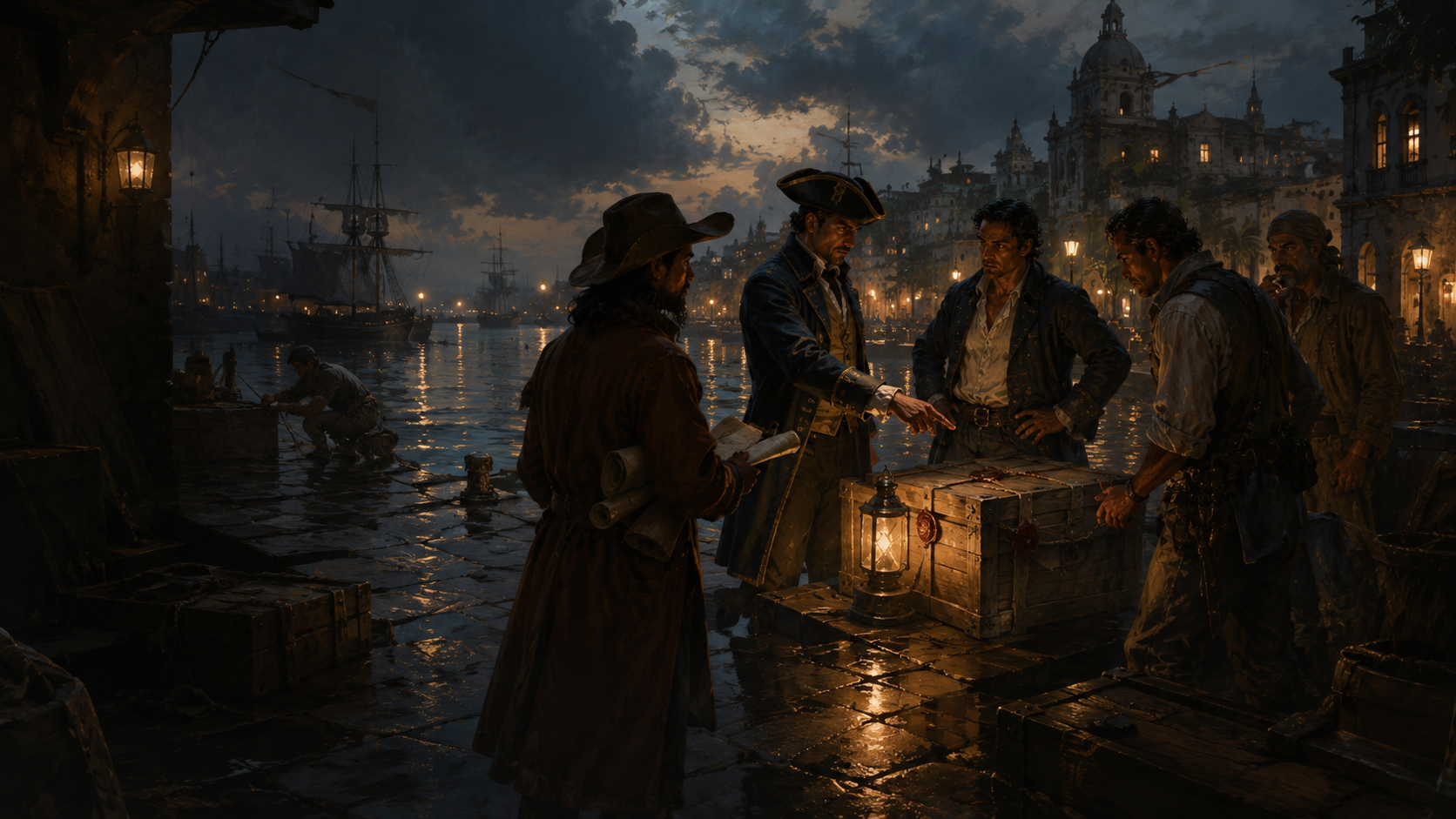
Licensed trade, letters, and coin#
Colonial trade in Mar de Oro is not a free market in any sense that the word implies. Every major commodity that moves through the archipelago moves under a license, a monopoly grant, a crown charter, or a company seal that ultimately traces back to one of the continental powers. Stroomdijk's avondrekening system assigns extraction quotas to company agents and accounts for variance with a precision that is either admirably efficient or deliberately designed to make fraud difficult to prove, depending on your relationship to the company. Valdegracian trade law requires that Mar de Oro exports travel through Principalia-licensed factors and be taxed at a rate that has been adjusted upward three times in the last decade without a corresponding adjustment in what the license costs to obtain. Albionis operates through crown-granted trading companies that are technically private but whose leadership overlaps with the Bureau of Correspondent Affairs to a degree that the Bureau does not encourage discussion of. Against this structure sits everything else. Unlicensed trade, which is the dominant form of trade in the archipelago by volume if not by official record, runs through the independent harbors, the factor houses of Éirighdún that do not appear on Valdegracian customs manifests, and the informal credit networks maintained by local merchants who have been in the archipelago longer than any of the continental powers and who have their own accounting systems that predate the colonial period. Canula Prime, as a Valdegracian-governed free port with a governor who reports directly to the crown and not to the colonial administration, occupies a specific position in this informal economy: officially regulated, practically flexible, a place where cargoes whose origin does not bear close inspection can clear without the documentation that a normal port would require.
The letter of marque is a license to operate outside the law while technically remaining inside it. A crown authorizes a private vessel to conduct military operations against specified enemies or to operate in restricted waters, and in exchange the vessel's captain accepts accountability to the crown's legal framework while retaining the practical independence that a naval commission does not provide. In Mar de Oro, letters of marque are more common than official naval records suggest, because every power in the archipelago has found it useful to have vessels operating without the formal diplomatic consequences that a naval engagement would produce. The letter is a fiction that all parties find useful, and the fiction is maintained with care on all sides. The dispatch is the information economy's primary instrument. A dispatch from the colonial governor to the Principalia takes weeks by sea under favorable conditions. By airship, under favorable conditions, the same message arrives in days. This difference is not abstract; it is the difference between a response that arrives while the situation described still exists and a response that arrives after decisions have already been made by people on the ground who could not wait. The powers that can afford regular airship dispatch service have a structural advantage in colonial administration that no amount of efficient sea-borne communication can fully compensate for. The powers that cannot afford it have learned to compose dispatches that anticipate rather than describe, authorizing their colonial administrators to act on conditions that may obtain rather than reporting conditions that did obtain.
The signal tower network in Mar de Oro is partial, contested, and in three places actively maintained by factions with conflicting interests in what information it carries. Albionis constructed the eastern relay chain; Valdegracia operates the primary chain connecting the largest harbors; there is a third network, shorter and not on any official chart, that the Éirighdún factor houses maintain between their own premises. The overlap and gaps in these networks are known to anyone who uses them professionally, and what can be transmitted, intercepted, delayed, or misdirected through them is a subject of permanent practical interest to the Bureau of Correspondent Affairs.
The archipelago runs on at least four currencies in common circulation and several more that are recognizable to specialists. Valdegracian ducats are the dominant denomination for large transactions and official commerce. Albionis shillings are common in the eastern harbors and wherever Albionis trading companies operate. Hellerite scrip, technically a debt instrument issued against the Duchy's Éterlumin assessments, has achieved the status of a local currency in the western archipelago with a stability that surprises people who know how recently the Duchy became autonomous. Several independent harbors issue their own tokens for local transactions, redeemable against commodities rather than against crown authority, which makes them resistant to the kind of devaluation that political instability produces in crown currencies. Credit is more important than coin for most significant transactions. The Éirighdún factor houses function partly as banks, maintaining the cuimhne ledgers that record credit relationships across the archipelago with a completeness that no official institution matches. A merchant who needs to move value from one harbor to another without moving coin does so through the factor house network, at a fee and under conditions that the factor house sets. The houses do not discuss their clients or their terms except with the clients themselves, a discretion that is not merely professional practice but constitutional to how they operate; a factor house that talked would cease to be a factor
Reading the gap in the record#
A crew that understands trade and signals has access to a layer of the world that most people moving through it do not see. The harbormaster's log is a record of what came in, which is also a record of what did not. The factor house that declines to extend credit is communicating something without saying it. The relay message that arrives ahead of any ship that could have carried it implies a vessel that is not on the official schedule. The letter of marque signed under one crown's seal found in a hold flying another crown's flag is either a mistake, a cover, or a situation that has changed since the document was issued. The colonial economy of Mar de Oro is a system in which information is the most valuable cargo, secrecy is a competitive advantage, and the official record consistently understates what is actually moving, because the official record is written by people who have reasons to understate it. A crew that can read the gap between the manifest and the hold, between the dispatch and the situation it describes, between the currency accepted and the currency offered, is a crew that is operating in the actual economy of the archipelago rather than the one that appears on the colonial administration's books.
Continue reading