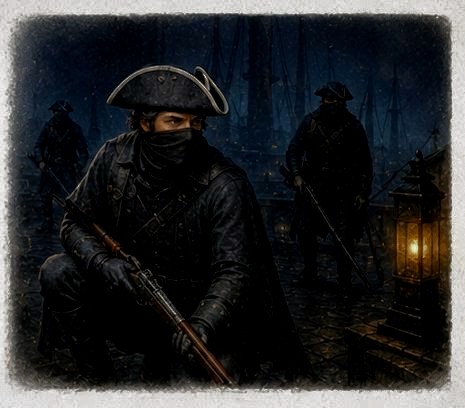
Use Mar de Oro with any ruleset. Begin with the fiction, choose the mechanics second.
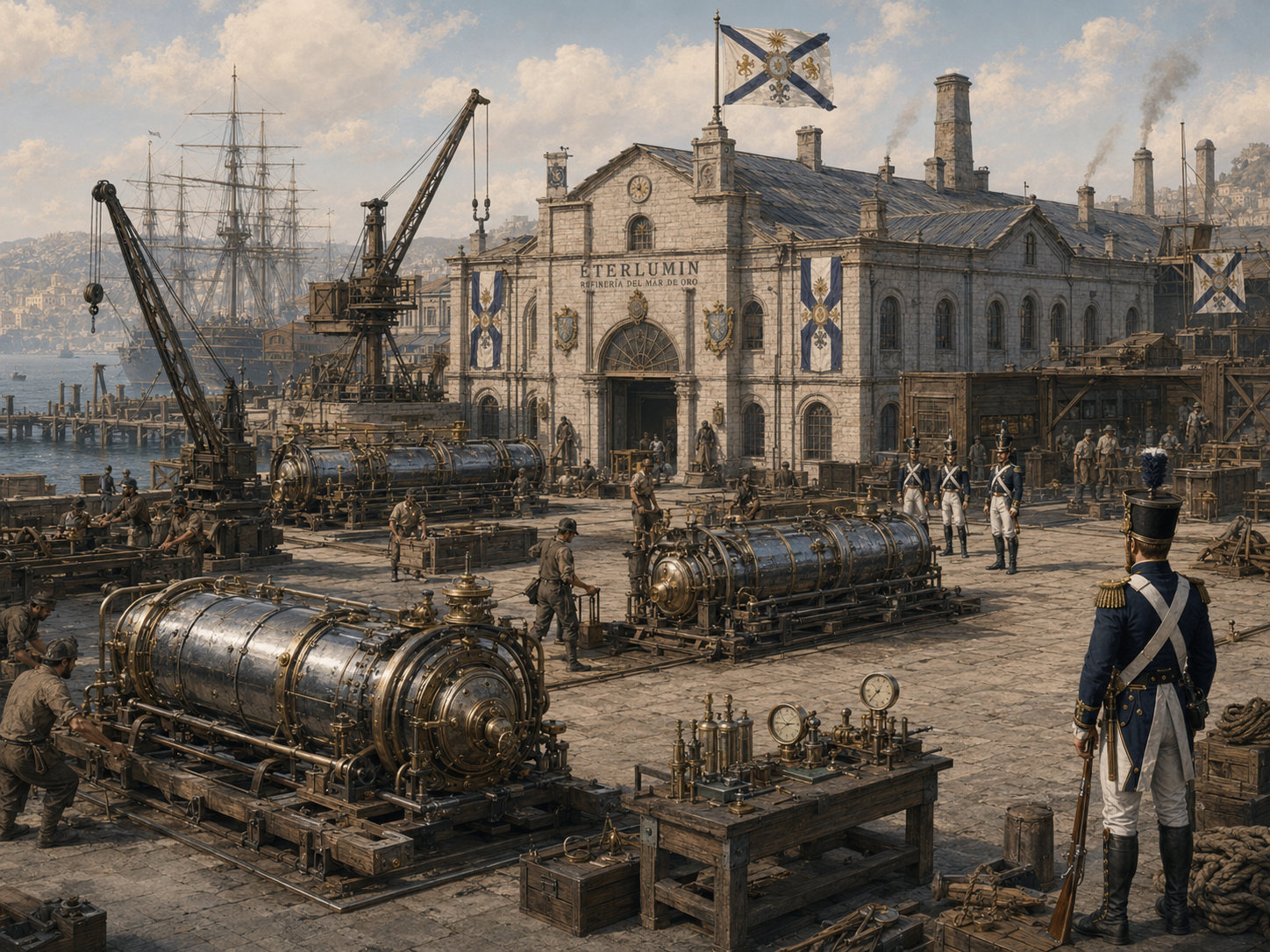
The cartographer's window over San Lucas. Any system can chart these waters.
Overview
Use Mar de Oro with Any Ruleset
Mar de Oro is a system-neutral setting.
Its nations, factions, technologies, conflicts, mysteries, characters, and campaign structures do not depend on classes, levels, spell lists, fixed statistics, or any particular method of rolling dice.
The setting was originally developed and played using Dungeons & Dragons Fifth Edition because that was the system familiar to the group at the time. Its D&D 5e conversion is therefore the most extensively tested mechanical implementation currently available.
This does not make D&D 5e the official or required Mar de Oro system.
In retrospect, Blades in the Dark may provide an especially natural fit for several of the setting's central concerns, including crew-centred campaigns, faction pressure, difficult choices, accumulating consequences, and fiction-first action. The group was not familiar with Blades in the Dark when the original campaign was played, so its conversion should be treated as adaptation guidance rather than an equally tested implementation.
The purpose of this chapter is not to declare one system correct. It is to help you preserve the identity of Mar de Oro in whichever ruleset your group chooses.
What System-Neutral Means
System-neutral does not mean mechanically empty.
It means the setting explains:
What exists.
What people can do.
How institutions exercise power.
What pressures shape the world.
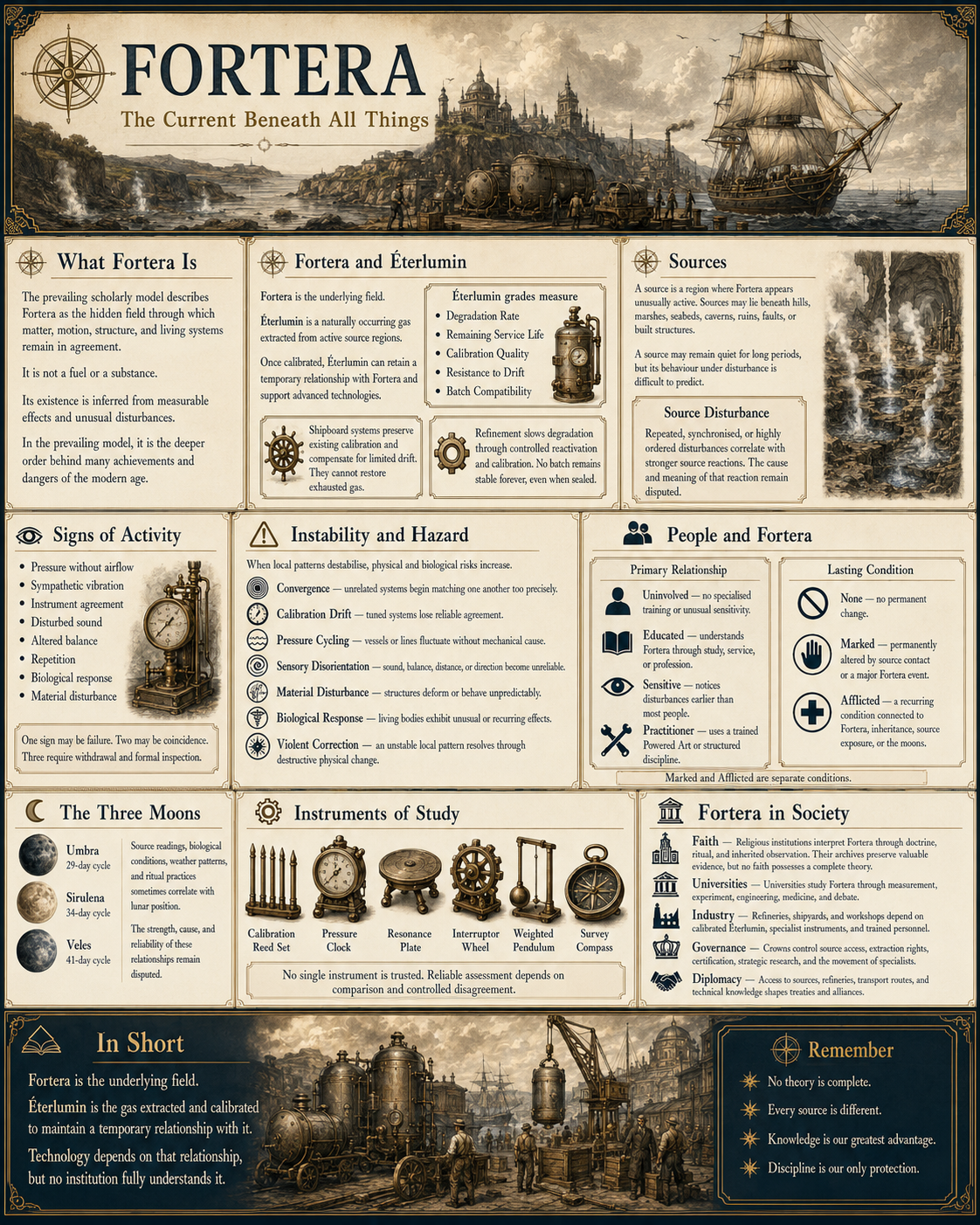
What risks accompany Fortera and Éterlumin.
What consequences follow from action.
What characters may gain, lose, protect, or become responsible for.
Mar de Oro provides:
Character capabilities.
Bonds and Burdens.
Faction relationships.
Political and social pressures.
Vessel roles and conditions.
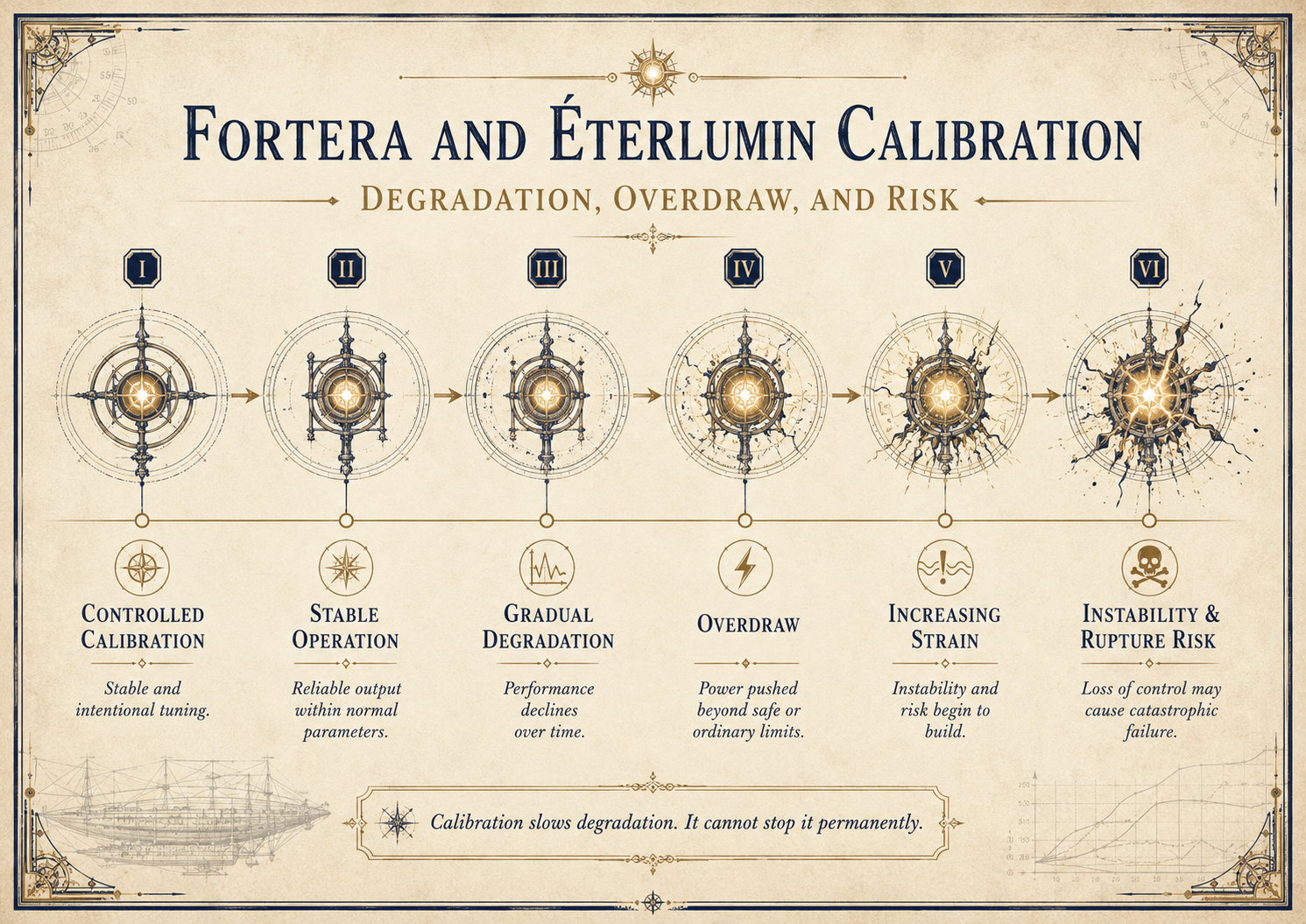
Éterlumin degradation.
Fortera strain and Overdraw.
Threat behaviour.
Consequences and escalating complications.
Guidance for travel, conflict, investigation, and extended challenges.
Your chosen system determines how those elements are resolved.
A capability might become a skill bonus, proficiency, action rating, aspect, background, approach, move, permission, or dice pool.
A vessel problem might become a damage track, progress clock, extended test, challenge sequence, or series of linked scenes.
The mechanical expression may change.
The fictional meaning should remain stable.
The Ladder
The Adaptation Ladder
Any character, creature, vessel, institution, hazard, or situation can be adapted by answering six questions.
Statistics chosen before fictional purpose may produce a functional game mechanic, but they may not produce an accurate representation of Mar de Oro.
Step One
Establish the Fictional Role
Determine what the subject does in the story.
Common roles include:
Ally
Rival
Authority
Obstacle
Threat
Mystery
Resource
Opportunity
Environmental hazard
Campaign pressure
A Valdegracian marine, for example, is not defined first by an armour class, attack value, or damage die.
The marine is a disciplined professional soldier who:
Maintains formation under pressure.
Follows orders reliably.
Works effectively with trained comrades.
Benefits from coordinated leadership.
Represents the authority of the Valdegracian state.
The chosen ruleset should express those qualities.
A merchant company might be a source of employment, an institutional rival, or a campaign-level threat.
An airship might be transportation, a mobile refuge, a military asset, a political symbol, or a failing objective.
A priest might be an ally, an authority, a keeper of forbidden knowledge, or someone trapped between doctrine and conscience.
The same setting element may fulfil different roles in different campaigns.
Step Two
Establish Capability
Mar de Oro uses four capability ranks:
Familiar
Trained
Expert
Master
These ranks describe fictional competence.
They do not correspond to fixed bonuses, target numbers, character levels, dice sizes, or automatic success.
Familiar
The character understands the fundamentals and can assist competently.
A Familiar practitioner may:
Recognise common tools and procedures.
Understand basic terminology.
Identify obvious dangers.
Assist someone more experienced.
Complete straightforward tasks under favourable conditions.
They may struggle when working alone, under severe pressure, or without suitable equipment.
Trained
The character can perform the work professionally under ordinary conditions.
A Trained practitioner may:
Carry out routine duties without supervision.
Use appropriate tools correctly.
Recognise common complications.
Work reliably under moderate pressure.
Contribute meaningfully to a professional team.
Most professional soldiers, sailors, engineers, investigators, physicians, navigators, and officials are Trained in the capabilities central to their occupation.
Expert
The character can handle difficult cases, supervise others, recognise unusual problems, and teach the discipline.
An Expert practitioner may:
Solve problems beyond routine training.
Lead complex work.
Identify hidden or uncommon dangers.
Develop unconventional solutions.
Judge the work of less experienced practitioners.
Maintain control under serious pressure.
Experts are trusted with substantial responsibilities.
Master
The character is among the finest practitioners in the region.
A Master practitioner may:
Resolve exceptional problems.
Develop new methods.
Influence institutions and professional doctrine.
Recognise patterns almost invisible to others.
Achieve results considered impossible by lesser practitioners.
Operate effectively under extreme conditions.
Mastery should remain rare and significant.
No Relevant Training
A character without relevant training may still attempt an action when the fiction permits it.
However, they may:
Require assistance.
Need additional time.
Depend on improvised methods.
Lack access to specialised options.
Risk more serious consequences.
Fail to recognise hidden dangers.
Be unable to complete the task without instruction.
Capability influences what a character can reasonably attempt and how safely they can attempt it.
It does not guarantee success.
Preparation, equipment, information, relationships, authority, and circumstances remain important.
Capability Translation Reference
Capability
Fictional Meaning
Common Mechanical Expression
No Relevant Training
May attempt the task only when circumstances permit
Exceptional permission, signature ability, major effect
These are examples rather than universal numerical values.
Always calibrate them to the chosen system.
Step Three
Determine Scale
Scale describes the level at which an action, threat, organisation, or consequence operates.
Capability and scale are separate.
An Expert engineer may be able to repair one airship but cannot personally resolve a regional shortage of calibrated Éterlumin without political support, infrastructure, and resources.
Personal Scale
Personal scale concerns one person, creature, room, mechanism, or immediate confrontation.
Fighting a duel.
Treating an injury.
Examining a damaged mechanism.
Negotiating with an official.
Escaping a guarded chamber.
Following a suspect through a city.
Crew Scale
Crew scale concerns a small group, patrol, household, shipboard team, or local operation.
Coordinating a boarding party.
Infiltrating an estate.
Protecting a diplomatic delegation.
Investigating a local smuggling network.
Managing a shipboard repair team.
Holding a defensive position.
Vessel Scale
Vessel scale concerns an airship, fortification, military company, large expedition, refinery, or major industrial installation.
Disabling an airship.
Defending a refinery.
Managing a vessel during a storm.
Assaulting a fortified harbour.
Evacuating a settlement.
Restoring a damaged communication array.
Faction Scale
Faction scale concerns a government, church, company, fleet, noble house, intelligence service, military command, or organised movement.
Exposing a company conspiracy.
Dividing a military command.
Damaging a noble house's legitimacy.
Changing relations between governments.
Disrupting a trade network.
Influencing the policy of a church or ministry.
Regional Scale
Regional scale concerns a war, widespread disaster, political crisis, economic collapse, or major failure of infrastructure.
Ending a blockade.
Preventing a war.
Containing a widespread Éterlumin crisis.
Changing control of the Golden Sea.
Exposing a truth that destabilises several nations.
Restoring a damaged regional communication network.
Acting Across Scale
A lower-scale action does not normally defeat a higher-scale threat by itself.
Characters may instead:
Discover a vulnerability.
Secure an alliance.
Sabotage a critical resource.
Expose hidden information.
Discredit a leader.
Disrupt supply or communication.
Change public opinion.
Create an opportunity for a larger force.
Turn one faction against another.
A personal action may begin a faction-level transformation, but connected actions, allies, and sustained effort will usually be required.
Scale should make institutions and regional conflicts feel substantial without making individual characters irrelevant.
Crossing Scale
Starting Scale
Higher-Scale Objective
Useful Leverage
Personal
Influence a crew
Leadership, evidence, reputation, sacrifice
Crew
Disable a vessel
Boarding, sabotage, command, engineering
Vessel
Pressure a faction
Blockade, public victory, captured intelligence
Faction
Change a region
Alliances, trade control, military action, legitimacy
Personal
Harm a faction
Exposure, testimony, sabotage, political leverage
A lower-scale action can matter greatly when it targets the right vulnerability.
Step Four
Define Pressure
Pressure is the force that makes a situation urgent, dangerous, or difficult.
It explains why the characters cannot continue indefinitely without the circumstances changing.
Common pressures include:
Time running out.
Increasing suspicion.
Political exposure.
Limited supplies.
Damaged equipment.
Hostile weather.
Approaching reinforcements.
Declining crew morale.
Unstable Fortera conditions.
Éterlumin degradation.
A relationship under strain.
An obligation becoming due.
An enemy advancing its plan.
Public unrest.
A vessel losing altitude.
A faction withdrawing support.
Pressure should be visible in the fiction.
Players should understand what is worsening and why action matters.
Your chosen system may represent pressure through:
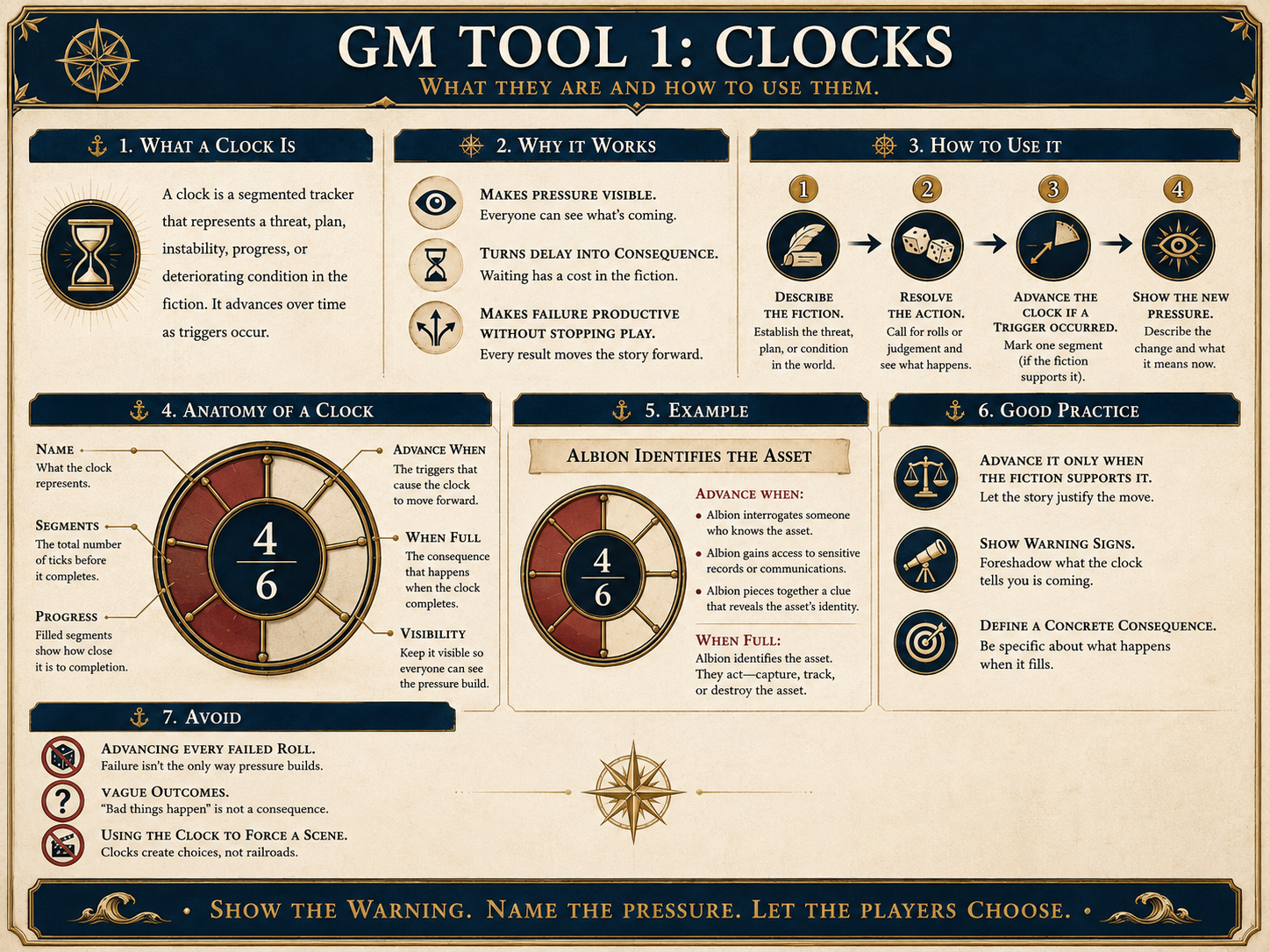
Progress clocks.
Countdown tracks.
Escalating difficulty.
Diminishing resources.
Stress.
Conditions.
Changing encounter states.
Enemy actions.
Narrative warnings.
Pressure should not exist only as hidden arithmetic.
Direct boarding, close weapons, fighting for decks and access points
Translate these bands into the distance, zones, movement rules, or positioning procedures used by the chosen system.
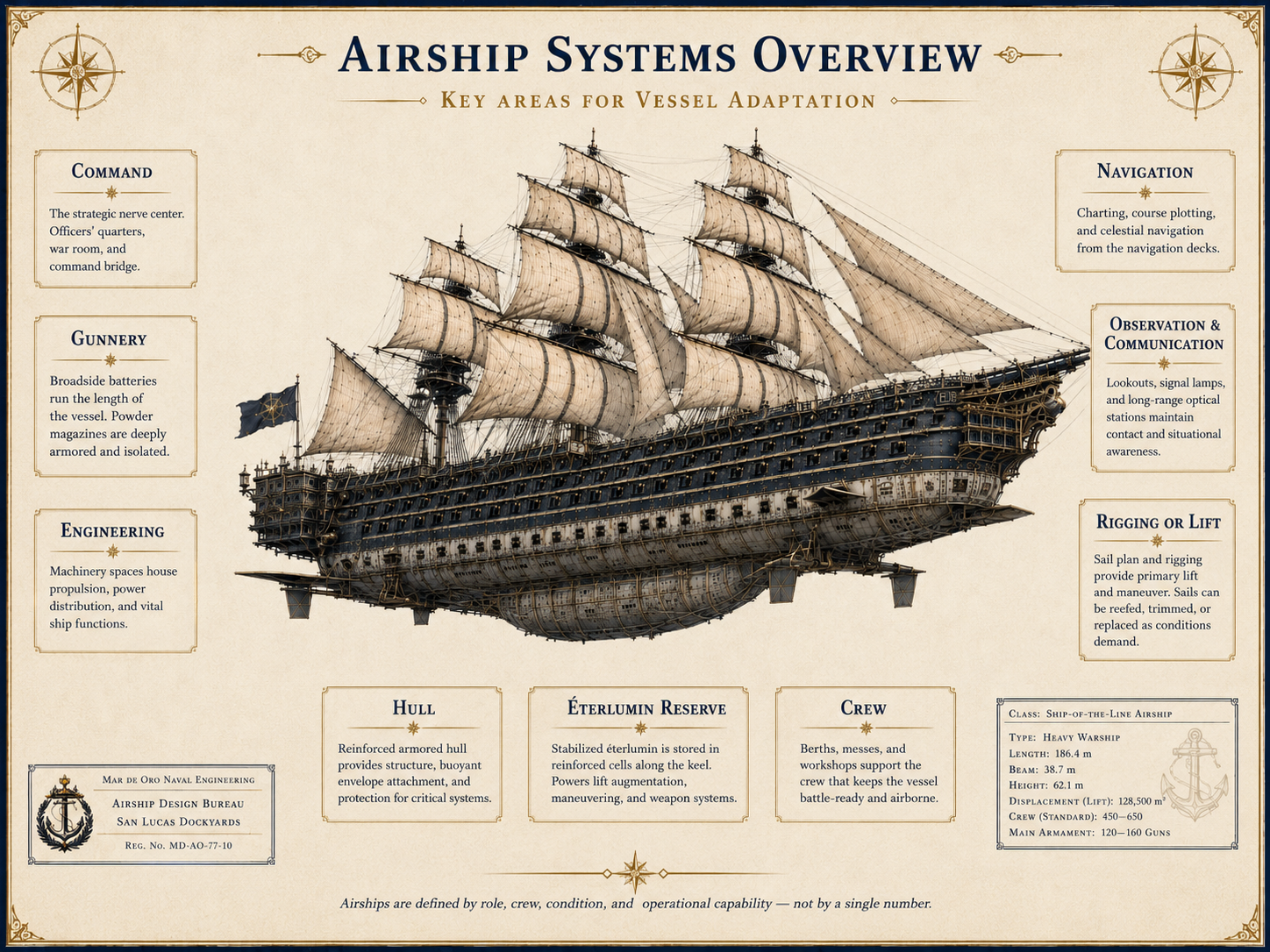
Character Roles During Airship Conflict
Characters should influence vessel conflict through meaningful responsibilities.
Possible roles include:
Command.
Navigation.
Engineering.
Gunnery.
Boarding.
Observation.
Damage control.
Fortera calibration.
Communication.
Medical support.
Airship conflict should not reduce player characters to passive passengers while the vessel resolves the battle around them.
Every major phase should present decisions that matter.
Extended Problems
Segmented clocks turn repairs, chases, negotiations, and investigations into visible, escalating pressure.
Complex repairs, investigations, diplomatic efforts, journeys, and long operations may be represented through:
Repair tracks.
Progress clocks.
Extended challenges.
Projects.
Multi-stage tests.
Accumulated successes.
Resource-driven procedures.
An extended problem should establish:
What must be accomplished.
How much progress is required.
Which capabilities are relevant.
What resources may be consumed.
What pressure continues while work proceeds.
What complications may result from failed attempts.
Failed attempts should normally introduce new problems rather than erase all progress.
Examples include:
The repair succeeds, but another system is damaged.
Progress is made, but supplies are consumed.
The fault is identified, but enemy forces arrive.
The mechanism works temporarily, but its service life is reduced.
The vessel is stabilised, but cannot regain full altitude.
The negotiation advances, but a new concession is demanded.
The investigation produces a name, but the target learns they are being watched.
Extended problems should create movement, escalation, and difficult choices.
Lasting Injuries
Serious injuries should matter beyond the immediate loss of health.
A lasting injury may affect:
Mobility.
Endurance.
Precision.
Confidence.
Reputation.
Professional duties.
Relationships.
Future obligations.
Access to particular roles.
Injuries do not need to remove a character from play.
They may instead change:
How the character approaches danger.
What assistance they require.
Which responsibilities they can perform.
How others perceive them.
What recovery demands from the crew.
Use the chosen system's rules for:
Healing.
Conditions.
Scars.
Trauma.
Recovery.
Long-term consequences.
Worked Examples
Three extended examples showing the ladder applied to a vessel, a faction investigation, and a Fortera crisis.
Interactive
Adaptation Worksheet
Use this worksheet when translating a character, threat, vessel, institution, hazard, location, or campaign element.
Interactive · Saves locally
Entries are stored only in this browser. No account, no upload.
What is being adapted?
What purpose does it serve in the story?
What does it want, require, or attempt to protect?
What makes it effective, influential, or dangerous?
What weaknesses, dependencies, limitations, or contradictions can be discovered?
What makes the situation urgent?
What may change if the characters fail, hesitate, or accept a cost?
Which statistics, rolls, moves, clocks, conditions, resources, or procedures will represent it?
What may require adjustment after play?
Preserving the Identity of Mar de Oro
Whatever system is used, retain the setting's core pressures.
Éterlumin always degrades.
Calibration slows degradation but cannot stop it permanently.
Airships require trained crews, infrastructure, maintenance, and political support.
Fortera offers extraordinary possibilities but requires discipline and control.
Violence creates legal, social, and diplomatic consequences.
Factions remember debts, betrayals, failures, and public humiliation.
Information may be more valuable than force.
Travel consumes time, supplies, and remaining service life.
Authority depends on recognition, reputation, and enforcement.
Relationships create both opportunities and obligations.
Large institutions cannot normally be defeated through one confrontation.
Personal actions can begin regional change, but they cannot replace alliances, organisation, and sustained effort.
Success may alter the balance of power even when no enemy is destroyed.
These principles are more important to the identity of Mar de Oro than any individual statistic.
Previously Published Table Procedures
The following procedures were originally published as part of the System Conversion Notes. They are preserved here because they apply across multiple rulesets.
Hard Calls at the Table
When the fiction, the dice, and the rules seem to disagree, the group is making a hard call. Handle these calls out loud, briefly, and in the open. Restate what the character is trying to accomplish, name the pressure and consequence already on the table, and confirm the intended stakes before committing to a ruling.
Prefer rulings that honour the fiction and the established capability of the character. Prefer consequences that keep the situation moving over consequences that erase progress. When a ruling turns out to have been wrong, correct it at the next natural pause rather than reversing rolls mid-scene.
Running the Powered Arts
The powered arts, including Fortera practice and its disciplined traditions, are part of the setting rather than a system layer. Run them by asking what the practitioner is trying to change in the world, what the local field can safely support, and what a deliberate push beyond that safe limit would cost.
Ordinary use remains within what local replenishment, personal discipline, and present conditions can safely support. An Overdraw is a deliberate attempt to exceed that safe capacity and must provide an exceptional benefit while also imposing Fortera strain, local instability, or another meaningful consequence.
Named-system pages link back to this section using the label System-neutral table procedures.
Playtesting and Conversion Status
Mar de Oro was originally developed and played using Dungeons & Dragons Fifth Edition because it was the system familiar to the group at the time.
The D&D 5e conversion is therefore the setting's most extensively tested mechanical implementation.
The System-Neutral Adaptation Ladder provides a shared foundation for translating Mar de Oro into other rulesets.
It preserves the setting's fictional identity, but it does not guarantee mechanical balance in every system.
Each group should calibrate:
Difficulty.
Damage.
Pacing.
Character resilience.
Vessel performance.
Resource consumption.
Recovery.
Long-term consequences.
No single rules engine is the official Mar de Oro system.
Choose a Ruleset
Four Ways to Bring Mar de Oro to the Table
Most extensively tested
Dungeons & Dragons Fifth Edition
D&D 5e supports familiar heroic adventure, structured character advancement, and recognisable tactical encounters. It is currently the most extensively tested Mar de Oro conversion.
Suggested checks and difficulties.
Creature and adversary profiles.
Equipment translations.
Fortera implementations.
Airship statistics.
Encounter guidance.
These mechanics are optional. They do not define the setting itself.
Adaptation guidance
Pathfinder Second Edition
Pathfinder 2e supports detailed tactical encounters, structured character options, and precise mechanical distinctions. Its Mar de Oro material should be treated as adaptation guidance unless a section is specifically identified as playtested.
Translate capabilities into skill and class structures.
Map Fortera disciplines onto class or archetype features.
Adapt vessel roles into subsystems and encounter modes.
Conversion page in preparation.
Natural thematic fit · Adaptation guidance
Blades in the Dark
Blades in the Dark may be an especially natural fit for Mar de Oro because of its emphasis on crew identity, faction relationships, accumulating pressure, position and consequence, difficult bargains, long-term projects, and fiction-first action.
Crews translate directly to Mar de Oro crews.
Position and effect express Fortera strain naturally.
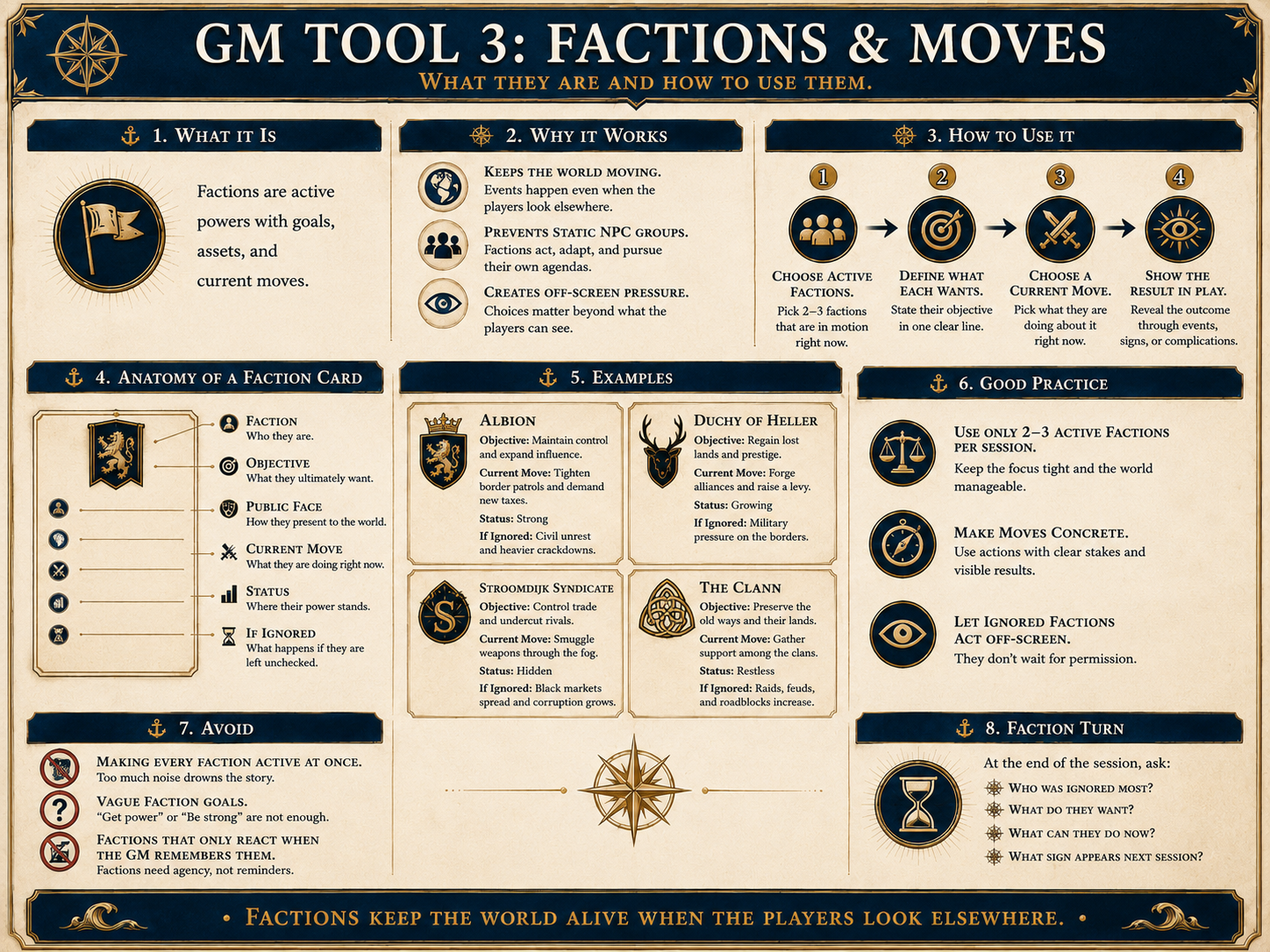
Faction clocks match the setting's pressure system.
Treated as adaptation guidance unless a section is specifically identified as playtested. Conversion page in preparation.
Lightweight standalone option
Optional 2d6 Resolution Bridge
Groups that prefer a lightweight standalone method may instead use the optional Mar de Oro 2d6 Resolution Bridge. The setting remains the same. Only the method of resolving uncertainty changes.
Other Systems. Other rulesets may be used by translating capabilities, scale, pressure, Bonds, Burdens, vessel roles, Éterlumin conditions, Fortera strain, faction influence, and consequences. The setting remains the same. Only the method of resolving uncertainty changes.