Skip to content
Mar de Oro
Nations of Aeon

A Power of Aeon

Albionis

The Old Kingdom. The Naval Crown. The Power That Built an Empire Before Anyone Agreed to Let It.

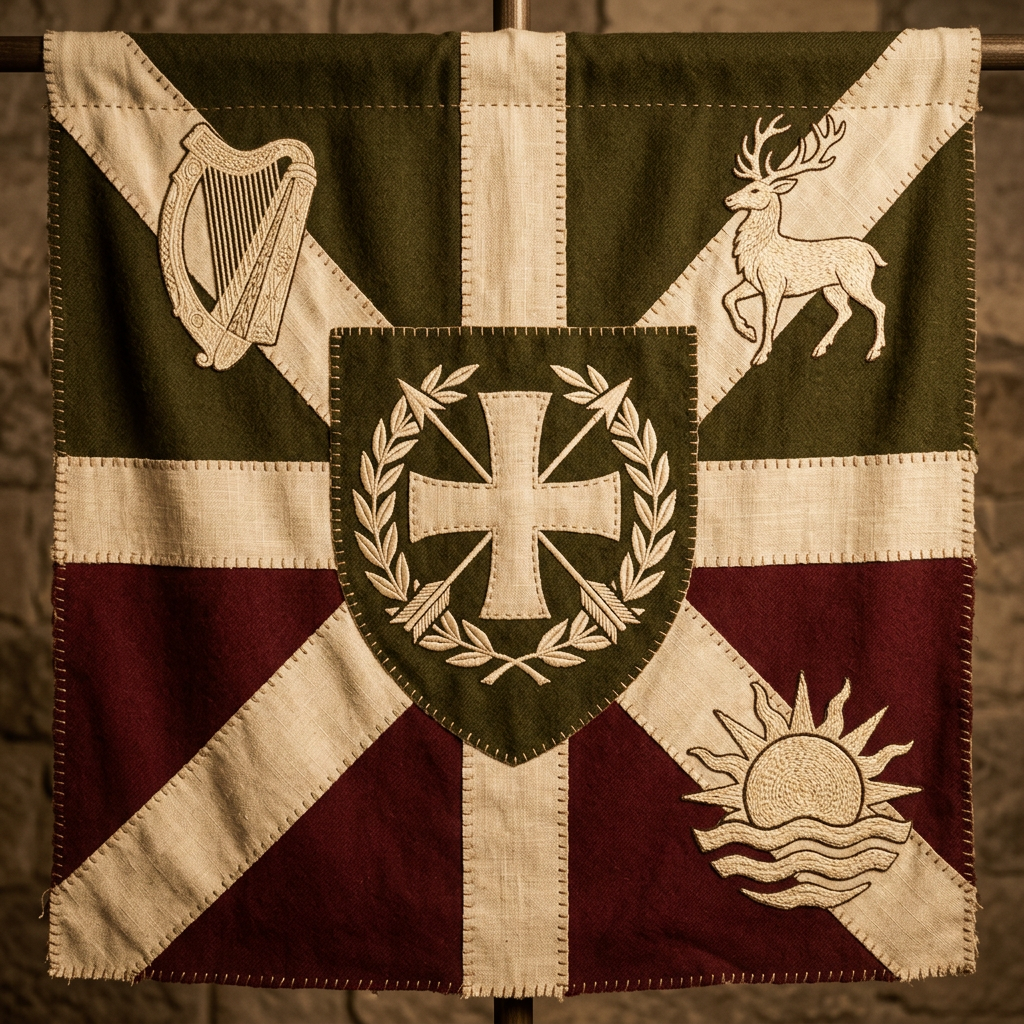
Albionis is a maritime kingdom of ancient habit and naval genius, built on commercial calculation, quiet intelligence, and the settled confidence of a crown that believes civilization has a shape and Albionis lies near its center.

Governance & Culture

At a glance

Political Order
Constitutional monarchy. The King retains significant power but must consult with Parliament on key decisions, particularly those affecting domestic affairs and legislation, balancing royal authority with democratic governance.
Religion
Predominantly follows the Luminary Fellowship, emphasizing individual enlightenment and a personal connection to the divine.
Capital

Regalport

A bustling coastal city known for its grand harbor, Regalport is the political and cultural heart of Albionis. It boasts impressive architecture, including the royal palace and the Parliament House, symbolizing the balance of power within the empire.
Language

Albionic

Albionic is the primary language of Albionis. It has a rich literary tradition and is used in official documents, literature, and everyday communication.

A History Built on the Water

Albionis is an island kingdom, or rather a congeries of islands and a long peninsula situated at the northwestern edge of the continental world, separated from the nearest major landmass by a stretch of channel water whose storms have historically served it better than any fleet. The channel is not wide. It has, on several occasions, been nearly crossed by powers that believed Albionis could be reduced by a determined crossing. Those powers have not made that error twice. The kingdom's expansion into the wider world followed the logic of the crown rather than the counting house. Where Stroomdijk sends a company, Albionis sends a flag. Where Stroomdijk issues a charter, Albionis issues a commission. The colonial establishment at New Avalon is administered in the crown's name, by officials who answer to the crown, under laws that derive from the crown's authority. This is not merely symbolic. It means that Albionis's colonial project is coherent in a way that company-governed territories are not: the governor of New Avalon knows who he serves, what he is authorized to do, and what the crown expects of him. The crown, for its part, knows what it has. This approach has made Albionis, over the course of the last century and a half, the second most consequential power in Mar de Oro, and by some measures the first. Its territorial footprint is smaller than Valdegracia's. Its information network is not. The agents that Albionis stations in colonial ports, the captains its ships carry who double as intelligence officers, the commercial factors whose accounts conceal regular reports to a quiet office in the capital, these constitute a map of the world that no other power has attempted to draw with the same systematic rigor. It is not complete. It is the most complete.

The Institutions

The kingdom is governed through the crown and its institutions: the Admiralty, which is among the most powerful governmental bodies in the known world; the Colonial Office, which administers New Avalon and the crown's other overseas holdings; and the Parliament, a body of landed nobility, clergy, and significant property-holders whose cooperation the crown requires for taxation and which has, over several generations, accumulated a degree of practical authority that it exercises with considerable care not to be seen exercising. The relationship between crown and parliament in Albionis is not a clean division of powers. It is a long-running negotiation between two parties who have found it mutually convenient never to force a final reckoning on who is ultimately in charge. The kingdom also maintains the Royal Hydrographic Survey, which is technically a scientific institution and practically a national intelligence asset of the first order. Every chart produced by Survey captains becomes a crown property. Every coast they have mapped is a coast Albionis can navigate with confidence and rivals cannot. In Mar de Oro, the Survey's charts are fifty years more current than anyone else's. This is not a coincidence either.

Albionis in Mar de Oro

In the Golden Sea, Albionis presents itself on two levels simultaneously. The visible level is the crown: Royal Navy vessels patrolling sea lanes with a frequency that is not quite military occupation and not quite neutral shipping, a Colonial Office mission in Boca Serena managing the relationship between New Avalon's governors and the crown that appointed them, official representatives who carry themselves with the settled authority of a state that considers its own legitimacy self-evident. The authority they represent is not commercial. It is constitutional. The less visible level is the Bureau of Correspondent Affairs, which is the name Albionis gives to its foreign intelligence service, and which has been operating in Mar de Oro since the first Albionite ships arrived. The Bureau does not advertise its presence. Its agents are factors, ships' physicians, harbor pilots, cartographers, the kind of people who move through a port without attracting notice and who have professional reasons to know things. The harbor pilot who knows every shoal in the approach is Albionite. The factor who can provide letters of credit drawn on Albionite banks is sitting in an office overlooking the main quay and has, somewhere in a locked drawer, a correspondence cipher and a standing brief. An Albionite naval captain operating in Mar de Oro typically carries two sets of orders: the official commission, which he will show if asked, and the Bureau instructions, which he will not. The two are not always pointing in the same direction. Managing that gap is considered part of the posting.

What an Albionite Carries

The character formed in Albionis carries a settled relationship to hierarchy and institution: a belief that structure is real, that the obligations it creates are binding, and that a person who fulfills those obligations earns a form of dignity that no amount of wealth or cleverness can quite substitute for. This is not servility. Albionites push back against authority they consider illegitimate. But they push back through forms, through petition, Parliament, the courts, the long processes of legitimate grievance. The idea of simply ignoring an obligation because it is inconvenient strikes most Albionites as the kind of thing other nations do. They also carry a habit of observation that is not always visible as such. Albionis produces, in quantities that other nations find mildly alarming when they notice it, people who are very good at reading rooms, tracking relationships, noticing what is absent from a conversation as much as what is present, and filing those observations somewhere useful. This is not a Bureau trait specifically; it is a cultural one. Albionite education, from the naval academies to the colonial service training, treats the accurate assessment of a situation as a foundational skill, and the people who come through it carry that assessment instinct into whatever they do next. An Albionite character who has never worked for the Bureau still notices things. The ones who have worked for the Bureau have learned what to do with what they notice. They carry a comfort with the sea that is unsentimental and proprietary: the ocean is something their kingdom has historically owned in practice if not in law, and they move across it with a confidence that reads to others as either inspiring or insufferable depending on how recently Albionis has done something they resent.

A concrete detail

One concrete detail: Albionite officers of any service, naval, colonial, or diplomatic, carry a small leather-bound journal called a duty book, in which they record, in their own hand, every significant decision they make in the execution of their commission, along with the reasons for it. The practice is not officially required. It is culturally mandatory. An officer who cannot account for his decisions has failed at something more fundamental than the decision itself. The books accumulate over careers and are sometimes, after death, presented to the service archives. The archives are not public. The practice is known to exist. Everyone behaves accordingly.

Regiments & Field Kit

Uniforms of the nation

Albion Line Infantry

Red coats, white belts, cold iron

The regulars of the Crown of Albionis: red coats, disciplined volleys, and a bayonet at every third pace. Their colours carry lions and cross, and they hold ground where other armies have already broken.

Albion Special Operations Service

Unseen. Unheard. Unconfirmed.

Black operations of the Bureau of Correspondent Affairs. Tricorn low, face covered, cape shedding rain. Sabotage, extraction, and quiet steel where no red coat is ever admitted to have walked.